There are many surprising things and unusual materials in the world, but these can fairly claim a place in the category of “the most surprising of those thought up by people”. Of course, these substances only “break” the rules of physics at first sight; in reality everything was explained scientifically long ago, though that does not make the substances any less surprising.
1. Ferrofluid
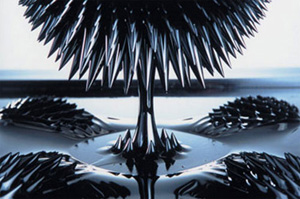 Ferrofluid is a magnetic liquid out of which highly curious and intricate shapes can be formed. While there is no magnetic field, though, a ferrofluid is viscous and in no way remarkable. But as soon as a magnetic field is applied to it, its particles line up along the field lines – and create something indescribable…
In practice ferrofluids are put to various uses: for providing thermal conduction in loudspeakers, for instance, but the use demonstrated here is also rather good.
And the ability to become now solid, now liquid, depending on the magnetic field applied, makes this material important for the motor industry, for NASA and for the military.
2. Aerogel, “frozen smoke”
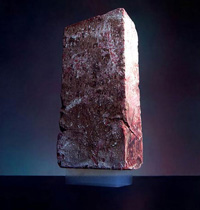 Frozen Smoke aerogel is 99 per cent air and 1 per cent silica. The result is a rather impressive piece of magic: bricks hang in the air and so on. Besides that, this gel is fire-resistant as well.
One variety of aerogel is the so-called Airglass, with a density of 0.05-0.2 grams per cubic centimetre. It is fairly transparent, and although it is not very strong, its thermal insulation is many times better than that of ordinary glass.
Engineers and scientists in general think that aerogel will soon be able to find dozens of areas of application on Earth. And here again space is a help. In recent years experiments on producing aerogel in weightlessness have been carried out on the shuttles.
Though almost invisible, aerogel can nevertheless support practically incredible weights, 4000 times greater than the volume of the substance used up, while it is itself very light. It is used in space: for “catching” dust from the tails of comets, for instance, and for “insulating” astronauts' suits. In future, scientists say, it will appear in many homes: it is far too convenient a little material.
3. Perfluorocarbon
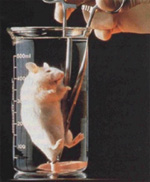 Perfluorocarbon is a liquid that holds a large amount of oxygen and that can, in effect, be breathed. The substance was being tested as long ago as the 1960s, on mice, and showed a certain degree of effectiveness. Unfortunately only a certain degree: the laboratory mice died after several hours spent in vessels of the liquid. Scientists came to the view that impurities were to blame…
Today perfluorocarbons are used for ultrasound examinations and even for making artificial blood. On no account may the substance be used without control: it is not the most environmentally clean. It “warms” the atmosphere, for instance, 6500 times more effectively than carbon dioxide.
4. Stretchable conductors
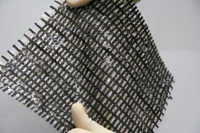 A matrix of transistors, like an elastic conductor, can be stretched. A group of researchers from the University of Tokyo led by Takao Someya has been the first to obtain an elastomer of high conductivity and chemical stability, by introducing carbon nanotubes into a polymer matrix.
The elastic material was obtained by mixing a black paste made by grinding the nanotubes in an ionic liquid – 1-butyl-3-methylimidazolium bis(trifluoromethanesulfonyl)imide. The grinding keeps the carbon nanotubes from sticking together into large “bundles”, which helps to lower their stiffness and makes for greater elasticity.
After grinding, the gel is combined with a fluorinated copolymer, which gives the material additional elasticity, and is left to set and dry. The film that results from all these operations is coated with silicone rubber, and an elastic conductor is thereby formed. To increase the elasticity further, the material can be perforated, and organic transistors can also be deposited on it. When all the production stages are complete, the result is an elastic sheet whose properties do not change when it is stretched by up to 70%.
To demonstrate that the approach proposed is realistic and economically effective, the Japanese researchers used a small-scale printer to produce a prototype elastic conductor measuring 20 by 20 cm. Takao Someya believes that the process of producing elastic conductors can be scaled up to the industrial manufacture of much larger flexible and elastic integrated electrical circuits. In the researchers' view this technique could lower the cost of making flexible displays, and could also create artificial skin for robots and interface systems for human-computer interaction.
5. Non-Newtonian fluid
Liquids whose viscosity depends on the velocity gradient are called non-Newtonian.
Scientists are looking for a way to use this ability of a non-Newtonian liquid in developing army equipment and uniforms, so that a soft and comfortable fabric would become hard under the impact of a bullet – and turn into body armour.
Scientists are looking for a way to use this ability of a non-Newtonian liquid in developing army equipment and uniforms, so that a soft and comfortable fabric would become hard under the impact of a bullet – and turn into body armour.
6. Transparent aluminium oxide
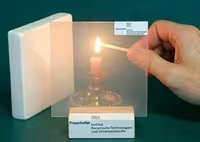
Transparent and at the same time strong metal is to be used both for creating better army equipment and in the motor industry, and even in the manufacture of windows. And why not: it is easy to see through, and it does not shatter.
Изображение
7. Carbon nanotubes
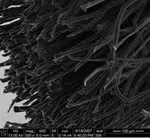
Carbon nanotubes have already appeared in the fourth item of the article, and here they are again. The reason is that their possibilities really are wide, and their various merits could be talked about for hours. In particular, they are the strongest of all the materials invented by man.
Изображение
Изображение
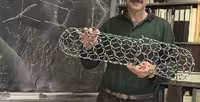
This material is already being used to make ultra-strong fibres, ultra-compact computer processors and a great deal else, and in future the pace will only be stepped up: super-efficient batteries, still more efficient solar panels and even the cable for the space elevator of the future…