AIM OF THE EXPERIMENT: To show the advantages of using a Möbius loop as a drive belt.
MATERIALS: an adult helper, two cotton reels, a ruler, a board (5 cm x 10 cm x 40 cm), two large nails, a hammer, scissors, a metre of wrapping paper, a green felt-tip pen, sticky tape.
MATERIALS: an adult helper, two cotton reels, a ruler, a board (5 cm x 10 cm x 40 cm), two large nails, a hammer, scissors, a metre of wrapping paper, a green felt-tip pen, sticky tape.
Изображение
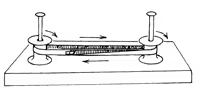
METHOD:
Ask your helper to stand the reels on a heavy board 30 cm apart and to fix them with the nails (the reels must turn freely on the nails).
Cut a strip of paper (2.5 cm x 100 cm) and colour one side with the felt-tip pen.
Wrap the paper strip round the reels, turn one end over so that the green side faces outwards, cut off the excess paper and tape the ends together. The loop must fit the reels exactly and turn freely.
Turn one reel clockwise.
Watch the second reel and see which colour of paper is passing round the reels.
RESULTS: Both reels turn clockwise. When the taped ends pass over a reel, the colour of the paper changes.
WHY? The reels and the paper strip are an example of a belt drive. Wheels joined by a belt turn in the same direction. Each time the taped ends pass over a wheel, the paper turns its other side up and we can see the “wrong” side. Belts that are not turned over like our paper strip wear out faster on the inside than on the outside. With such a turned loop (it is named after the mathematician Möbius, who discovered the phenomenon) the load falls equally on both sides of the belt, so that it wears more slowly.