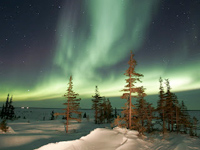
Auroras, also known as the northern and southern polar lights, are a natural light in the sky, and are usually observed at night. They usually occur in the ionosphere. As a rule, they are visible from 65 to 72 degrees of northern and southern latitude, forming a ring within the Arctic and the Antarctic.
An aurora forms when charged particles (electrons and protons) enter the atmosphere near the poles. When these particles collide with atoms and molecules of the upper layers of the atmosphere, primarily oxygen and nitrogen, part of the energy in these collisions is converted into visible light, which characterises the aurora. High-speed particles collide with atoms in the Earth's atmosphere at a height of somewhere from 50 to several hundred kilometres above the Earth's surface. The particles come from space, in particular from the solar wind blowing in the direction away from the Sun.
When electrons from space collide with atoms or molecules in the Earth's atmosphere, an electron passes to a higher energy level and the atom is in an excited state. After some time, the electron in the excited atom passes to its original low energy level. It releases energy as light, causing the glow of the auroras.
The colour of an aurora depends on the chemical composition, and each type of atom produces its own unique pattern of colour. Thus the different colours in auroras come from different elements in the Earth's atmosphere.
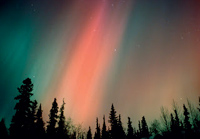
The two main atmospheric gases involved in an aurora are oxygen and nitrogen:
· Oxygen is responsible for the appearance of two main colours : yellow-green with a wavelength of 557.7 nanometres (nm) is the most common, while dark red 630.0 nm light is found less often. Atomic oxygen forms at great heights, so the red colour in an aurora is usually located above the green.
· Nitrogen in the ionised state will produce blue light, while neutral nitrogen molecules produce crimson-red colours. Nitrogen is often responsible for the purple-red lower borders and the corrugated edges of an aurora.
Mixtures of these colours form other colours.
Auroras, as a rule, do not occur above 500-1000 km , since at this height the atmosphere is too thin to provide a sufficient number of collisions with the incoming particles.
They are most noticeable closer to the poles because of the long periods of darkness and the magnetic field.
Almost all the planets of the Solar System have auroras. If a planet has an atmosphere and is bombarded by energetic particles, it will have auroras.
Planets such as Venus, which have no magnetic field, have a very "irregular" form of aurora, while the Earth, Jupiter or Saturn, which have their own magnetic dipole field, have oval-shaped auroras in the form of crowns in both hemispheres. When the magnetic field of a planet does not coincide with the axis of rotation, the result is a distortion of the oval of the auroras, which can be in the region of the equator, as on Uranus and Neptune.