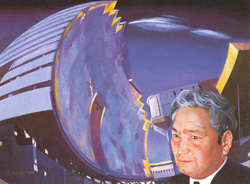
 Sadyk Azimovich Azimov (born 07.11.1914) is a Soviet physicist and an academician of the Academy of Sciences of the Uzbek SSR (1962). He was born in Tashkent. He graduated from Central Asian University (1940). In 1941-45 he was an assistant at the Central Asian Pedagogical Institute. In 1948—58 he was head of a laboratory and head of a department at the Physico-Technical Institute of the Academy of Sciences of the Uzbek SSR, and from 1966 its director, and in 1958—66 he was deputy director and then director of the Institute of Nuclear Physics of the Academy of Sciences of the Uzbek SSR. From 1954 he has also been head of a department at Tashkent University. His main research concerned high-energy physics and the physics of cosmic rays. Together with others he discovered the soft component of cosmic radiation and electron-nuclear lines. He carried out a series of studies of hyperfragments, of the mechanism of their formation, of the angular and energy distributions of the decay products, and of the interaction of protons and pions with nucleons. He detected the diffractive generation of pions by protons and by pions. He studied the interaction of cosmic rays with various nuclei at energies of 2*1011—2*1012 eV. He found that the mean inelasticity coefficient for π-mesons depends only weakly on the atomic number of the target nucleus, and that the inelasticity coefficients for pion-nucleus and for nucleon-nucleus collisions differ greatly. State Prize of the Uzbek SSR (1970)
Azimov, Sadyk Azimovich
Sadyk Azimovich Azimov (born 07.11.1914) is a Soviet physicist and an academician of the Academy of Sciences of the Uzbek SSR (1962). He was born in Tashkent. He graduated from Central Asian University (1940). In 1941-45 he was an assistant at the Central Asian Pedagogical Institute. In 1948—58 he was head of a laboratory and head of a department at the Physico-Technical Institute of the Academy of Sciences of the Uzbek SSR, and from 1966 its director, and in 1958—66 he was deputy director and then director of the Institute of Nuclear Physics of the Academy of Sciences of the Uzbek SSR. From 1954 he has also been head of a department at Tashkent University. His main research concerned high-energy physics and the physics of cosmic rays. Together with others he discovered the soft component of cosmic radiation and electron-nuclear lines. He carried out a series of studies of hyperfragments, of the mechanism of their formation, of the angular and energy distributions of the decay products, and of the interaction of protons and pions with nucleons. He detected the diffractive generation of pions by protons and by pions. He studied the interaction of cosmic rays with various nuclei at energies of 2*1011—2*1012 eV. He found that the mean inelasticity coefficient for π-mesons depends only weakly on the atomic number of the target nucleus, and that the inelasticity coefficients for pion-nucleus and for nucleon-nucleus collisions differ greatly. State Prize of the Uzbek SSR (1970)