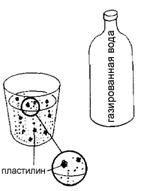
 AIM OF THE EXPERIMENT: To find out how the buoyancy of an object can be changed.
MATERIALS: a glass, fizzy water, modelling clay. METHOD: Fill the glass three quarters full with soda water and immediately drop in five small pieces of modelling clay (all at once). The pieces should be the size of grains of rice.
Wait a little and watch.
RESULTS: Bubbles form on the modelling clay. The pieces of clay rise to the surface, turn over and sink to the bottom again, where bubbles begin to cling to them once more, but now in greater numbers.
WHY? Fizzy water contains carbon dioxide, and it is this that forms the bubbles. At first the balls of modelling clay sink, because their weight is greater than the buoyancy force. The gas bubbles are like tiny balloons. They reduce the weight of the clay enough for it to float up to the surface. At the surface the bubbles disappear, so the balls of clay sink to the bottom again, where a large number of bubbles stick to them.