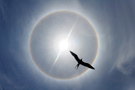
 One of the interesting optical phenomena is the halo. The term comes from the ancient Greek word halos, which means disc, circle, nimbus.
A halo is an optical phenomenon: luminous rings, pillars and spots around or near a source of light – the Sun, the Moon, a street lamp and so on. The cause of this phenomenon is the dispersion of light in ice crystals. Rays of light passing through ice crystals suspended in the air are refracted, forming luminous objects of various shapes.
The first mention of a halo is found in ancient chronicles. For example, “The Tale of Igor's Campaign” relates that before the advance of the Polovtsians “four suns shone over the Russian land”, which was taken as a sign of approaching misfortune. The appearance of a halo was seen as something mystical, and as a result it even made some adjustments to the history of humankind. Thus, for example, Charles V lifted the siege of the city of Magdeburg after a halo appeared in the sky, causing alarm among his comrades.
Like other physical phenomena, the halo interested scientists. The first theory of the halo was given by the French physicist E. Mariotte. The phenomenon was also studied by the Dutch astronomer Marcel Minnaert and others.
A halo should not be confused with a rainbow. A rainbow can be observed standing with one's back to the Sun, whereas a halo, apart from some rare types, is observed near the source of light. A rainbow is full-coloured. Unlike the full-coloured rainbow, a halo is in most cases faintly coloured. Moreover, unlike a rainbow, the red of a halo lies closer to the centre of the circle.
Halos of various kinds are known (about a hundred). They are caused mainly by ice crystals in cirrus clouds at a height of 5-10 km. The kind of halo observed depends on the shape and arrangement of the crystals.
There are classifications of halos by various features. For example, by colouring, halos are divided into: white halos (light, colourless, white arcs and spots); rainbow halos, faintly coloured (only red, orange and white); rainbow halos, full-coloured (blue and green are also visible).
There is also a classification of halos by their position in the sky: halos lying close to the Sun; halos at a distance of 46° and more from the Sun; halos encompassing the whole sky; halos lying in the part of the sky opposite the Sun; halos reflected in the plane of the horizon.
When observing a halo one should be careful, since a bright source of light can harm the eyes. The phenomenon can be recorded with photographic and video equipment, but because of the brightness such shots are often “overexposed”.