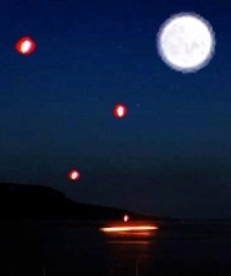
 Despite the ever-rising level of technological development, there remain in nature inexplicable, little-studied phenomena. One such phenomenon is the Naga fireballs.
The first documented mention of the phenomenon is contained in writings kept in the Wat Luang temple, which are several centuries old. The Naga fireballs are also noted in written reports of British servicemen dated 1960.
The natural phenomenon in question occurs on the Mekong River in the vicinity of the city of Nong Khai, in the north of Thailand. Fireballs, mostly red, orange or pink, appear above the surface of the river and move upwards. Eyewitnesses also report the formation of light green balls, however. Having risen a few metres, the balls disappear without a sound. Sometimes, though, the movement of a ball is accompanied by a barely perceptible whistling. The flight of a ball is short, lasting 5-7 seconds. The ball moves slowly, with a slight acceleration. The size of the Naga fireballs does not exceed one metre.
The phenomenon occurs at night, mostly in September and October, but can also be observed in spring. In one night anything from tens to thousands of Naga fireballs may form.
Scientists have put forward a number of theories of how the Naga fireballs form. One of the most probable is the theory of the formation in the water of “bubbles” of gases – methane and nitrogen. The gas enters the water either from the depths of the earth or from the muddy bottom, as a result of the decomposition of organisms. Having left the water, the “bubbles” ignite because of a potential difference. According to scientists, a number of factors must be met for the fireballs to appear: the temperature of the water, the combination of the effects of the gravitational fields of the Sun and the Moon, the level of ultraviolet irradiation of the water, and the thickness of the ozone layer of the atmosphere above the river.
The local people have a legend of their own about the phenomenon. They are convinced that the fireballs are produced by the seven-headed mythical serpent Naga. According to the legend, these balls are built into a staircase for the Buddha, by which he could return to earth and put the world of men in order.
A festival, Wan Awk Pansa, is devoted to the appearance of the Naga fireballs, and thousands of tourists try to attend it. The appearance of each ball is accompanied by the rejoicing of the spectators. A fireball is comparable in appearance to ball lightning, but appears in calm weather.
Whatever the theories of scientists about how the Naga fireballs form, people like to believe the legends about the phenomenon and to watch this beautiful “firework display”, given to us by nature.