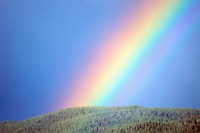
 Each of us has seen such a beautiful natural phenomenon as the rainbow. The first mentions of it were recorded in ancient Greek, ancient Indian and Scandinavian mythology. Ancient scholars tried to explain the origin of the rainbow. Scholars such as Qutb al-Din al-Shirazi (1236—1311), Kamal al-Din al-Farisi (1260—1320), Dietrich of Freiberg and others devoted their scientific works to this subject. Sometimes such explanations ended in the death of the scholar. Thus Archbishop Marco Antonio de Dominis, having set out a theory of how the rainbow arises, was sentenced to death by the Inquisition in 1611. The reason was that his theory contradicted the biblical interpretation of the origin of the rainbow. According to the Bible, the rainbow appeared after the Flood, as a symbol of the covenant between God and humankind, as a symbol of the forgiveness of humankind. However, science did not stand still, and in 1927 Isaac Newton, having carried out an experiment in which sunlight was split into a spectrum of colours with a glass prism, was able to supplement the theory of Descartes and de Dominis and finally establish the nature of the rainbow.
What exactly is a rainbow?
A rainbow is an atmospheric optical and meteorological phenomenon observed when sunlight interacts with water drops. It is an arc made up of seven colours (some cultures mention 6 colours). An interesting fact is that a rainbow can arise not only from direct action of the Sun: on a clear night it can be caused by light reflected from the Moon. The “water drops” can be rain or fog, or, for example, water sprayed by a watering device.
A ray of sunlight, or an ordinary ray of white light, is in fact a combination of colours, each of which has its own angle of refraction on passing through a water drop. This parameter depends on the wavelength of the colour. Thus for red the angle of refraction is 137°30’, and for violet 139°20’. The remaining colours (orange, yellow, green, light blue and blue) have some intermediate value. As a result, white light passing through a water drop is split into a spectrum (dispersion of light takes place).
A rainbow formed by one internal reflection of light is called primary. In it the red colour is on the outside of the rainbow. Sometimes a secondary rainbow, formed by light reflected twice in the drops, may be present beside the primary one. In such a rainbow the order of the colours is reversed (violet on the outside of the rainbow). Rainbows of higher orders appear extremely rarely in natural conditions, but can quite well be produced in laboratory conditions. Although the nature of the rainbow has long been understood, the phenomenon continues to delight and gladden us, bringing a measure of magic into this age of “high technology”.