AIM OF THE EXPERIMENT: To show how the speed of air affects the flight of an aeroplane.
MATERIALS: a small funnel, a table-tennis ball.
MATERIALS: a small funnel, a table-tennis ball.
Изображение
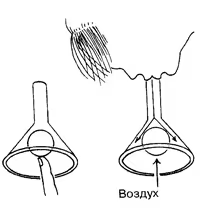
METHOD:
Turn the funnel wide end down.
Put the ball into the funnel and hold it up with your finger.
Blow into the narrow end of the funnel.
Stop holding the ball up with your finger, but keep blowing.
RESULTS: The ball stays in the funnel.
WHY? The faster the air passes the ball, the less pressure it exerts on the ball. The air pressure above the ball is much less than below it, and so the ball is held up by the air beneath it. Thanks to the pressure of the moving air, the wings of an aeroplane are as it were pushed upwards. Because of the shape of the wing, air travels faster over its upper surface than under the lower one. This is why a force arises that pushes the aeroplane upwards — lift.