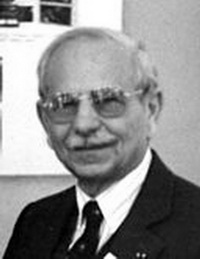
 Anatole Abragam (born 15.XII 1914) is a French physicist and a member of the Paris Academy of Sciences (1973). He was born in Moscow. He graduated from the University of Paris (1937). From 1947 he worked at the French Atomic Energy Commission (from 1955 as head of a laboratory, from 1971 as director of research) and from 1960 he was professor at the Collège de France.
His research was in the field of magnetism and solid-state physics, in particular nuclear magnetism, the hyperfine structure of solids, the theory of spin temperature, the polarisation of nuclei and the gamma-resonance spectroscopy of solids. In 1951, together with M. Pryce, he worked out the spin-Hamiltonian method, which plays a large part in the theory of paramagnetic spectra, and the theory of hyperfine-structure splitting. Independently of others he observed the Overhauser effect (1953). In 1958, together with W. Proctor, he discovered dynamic nuclear polarisation (the solid effect), which is used to obtain a polarised proton target, and in 1962 he built such a target. With the same colleague he gave an analytical definition of spin temperature for the case of a weak field and established experimentally that it exists and that it is identical with the thermodynamic temperature. He discovered nuclear antiferromagnetism (1970) and the nuclear precession of neutrons (1973).
In 1967 he was president of the French Physical Society. He founded a school of physicists.