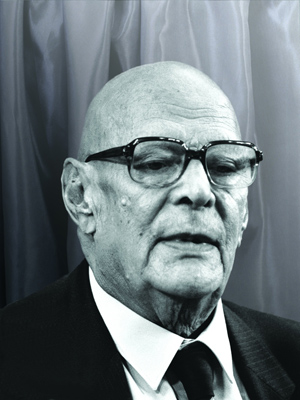
 Anatoly Petrovich Alexandrov (born 13.02.1903) is a Soviet physicist, an academician (1953; corresponding member 1943) and president of the USSR Academy of Sciences (since 1975). He was born in the town of Tarashcha (now in the Kiev region). He graduated from Kiev University (1930) and worked at the Leningrad Physico-Technical Institute of the USSR Academy of Sciences. In 1946-55 he was director of the Institute of Physical Problems of the USSR Academy of Sciences, and from 1960 of the I. V. Kurchatov Institute of Atomic Energy. His research concerned nuclear physics, solid-state physics, the physics of polymers and the construction of nuclear reactors. His first studies were in the physics of dielectrics and in the mechanical and electrical properties of high-molecular compounds. In 1935, together with S. N. Zhurkov and P. P. Kobeko, he developed the statistical theory of strength, which became part of the modern physical theory of the durability of solids. He was one of the founders of the physics of polymers. The main result of his research in this field was the working out of the foundations of the relaxation theory of the physical properties of polymers and its experimental justification. His studies of the elasticity and strength of rubbers and of the plasticisation of polymers were an important contribution to the problem of producing high-quality synthetic rubbers and plastics. During the Great Patriotic War he was the scientific director of the work on protecting ships against magnetic mines. Together with I. V. Kurchatov and V. M. Tuchkevich he developed a method of protecting ships against mines that was put to effective use (USSR State Prize, 1942). After the war, together with I. V. Kurchatov, he worked on creating Soviet atomic science and technology. In a short time he and the teams he headed carried out the complex and laborious physical research and development needed to solve the atomic problem. For many years he has been working on the scientific and technical problems of nuclear power. Under his scientific direction a number of powerful water-cooled, water-moderated reactors were created, installed in particular at the Novovoronezh nuclear power station and at the nuclear power station at Rheinsberg (GDR). He did much for the use of atomic energy in shipping, and was the scientific director of the world's first surface vessel with a nuclear engine — the nuclear icebreaker Lenin, and of the later nuclear ships Arktika and Sibir. He created a school of nuclear physicists. Three times Hero of Socialist Labour (1954, 1960, 1973), winner of the Lenin Prize (1959) and of USSR State Prizes (1942, 1949, 1951, 1953). The I. V. Kurchatov (1968), M. V. Lomonosov (1978) and S. I. Vavilov (1978) gold medals and others.
Alexandrov, Anatoly Petrovich
Anatoly Petrovich Alexandrov (born 13.02.1903) is a Soviet physicist, an academician (1953; corresponding member 1943) and president of the USSR Academy of Sciences (since 1975). He was born in the town of Tarashcha (now in the Kiev region). He graduated from Kiev University (1930) and worked at the Leningrad Physico-Technical Institute of the USSR Academy of Sciences. In 1946-55 he was director of the Institute of Physical Problems of the USSR Academy of Sciences, and from 1960 of the I. V. Kurchatov Institute of Atomic Energy. His research concerned nuclear physics, solid-state physics, the physics of polymers and the construction of nuclear reactors. His first studies were in the physics of dielectrics and in the mechanical and electrical properties of high-molecular compounds. In 1935, together with S. N. Zhurkov and P. P. Kobeko, he developed the statistical theory of strength, which became part of the modern physical theory of the durability of solids. He was one of the founders of the physics of polymers. The main result of his research in this field was the working out of the foundations of the relaxation theory of the physical properties of polymers and its experimental justification. His studies of the elasticity and strength of rubbers and of the plasticisation of polymers were an important contribution to the problem of producing high-quality synthetic rubbers and plastics. During the Great Patriotic War he was the scientific director of the work on protecting ships against magnetic mines. Together with I. V. Kurchatov and V. M. Tuchkevich he developed a method of protecting ships against mines that was put to effective use (USSR State Prize, 1942). After the war, together with I. V. Kurchatov, he worked on creating Soviet atomic science and technology. In a short time he and the teams he headed carried out the complex and laborious physical research and development needed to solve the atomic problem. For many years he has been working on the scientific and technical problems of nuclear power. Under his scientific direction a number of powerful water-cooled, water-moderated reactors were created, installed in particular at the Novovoronezh nuclear power station and at the nuclear power station at Rheinsberg (GDR). He did much for the use of atomic energy in shipping, and was the scientific director of the world's first surface vessel with a nuclear engine — the nuclear icebreaker Lenin, and of the later nuclear ships Arktika and Sibir. He created a school of nuclear physicists. Three times Hero of Socialist Labour (1954, 1960, 1973), winner of the Lenin Prize (1959) and of USSR State Prizes (1942, 1949, 1951, 1953). The I. V. Kurchatov (1968), M. V. Lomonosov (1978) and S. I. Vavilov (1978) gold medals and others.