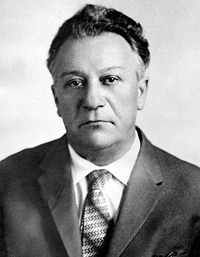
 Abram Isaakovich Alikhanov (04.03.1904 — 08.12.1970) was a Soviet experimental physicist, an academician (1943; corresponding member 1939) and an academician of the Academy of Sciences of the Armenian SSR (1943). He was born in the town of Kars. He graduated from the Leningrad Polytechnic Institute (1928). In 1927-41 he worked at the Leningrad Physico-Technical Institute of the USSR Academy of Sciences. In 1945 he set up the Institute of Theoretical and Experimental Physics, of which he was director until 1968. His research concerned nuclear physics, the physics of cosmic rays, the physics and engineering of nuclear reactors, accelerator engineering and the physics of elementary particles. In 1934, together with A. I. Alikhanian and M. S. Kozodaev, he discovered the formation of an electron-positron pair as a result of the internal conversion of the energy of an excited nucleus, and in 1936, together with A. I. Alikhanian and L. A. Artsimovich, he proved experimentally that energy and momentum are conserved in the annihilation of an electron and a positron. Together with Alikhanian he carried out precision studies of the beta spectra of a large number of radioactive elements, and found that the shape of the spectrum depends on the atomic number of the element. The two of them were also the first to propose the idea of experiments to prove that the neutrino really exists, from the recoil nuclei in K-capture in 7Be, and they carried out a series of experiments on the physics of cosmic rays on Mount Aragats which stimulated the development of a new field — the physics of elementary particles. He took part in the creation of the first Soviet nuclear reactors, and led the heavy-water line of work on nuclear reactors. In 1949 he and his colleagues started up the first Soviet heavy-water research reactor. In 1957 he measured the longitudinal polarisation of electrons in beta decay, which made it possible to establish with high accuracy the non-conservation of time parity in weak interactions. He made a considerable contribution to the development of the experimental base of high-energy physics. He took part in the construction of the first strong-focusing proton synchrotron in the USSR, at 7 billion eV (it came into operation in 1961), and laid the foundations of the design of the Serpukhov proton accelerator at 70 billion eV. Hero of Socialist Labour (1954). USSR State Prizes (1941, 1948, 1953).
Alikhanov, Abram Isaakovich
Abram Isaakovich Alikhanov (04.03.1904 — 08.12.1970) was a Soviet experimental physicist, an academician (1943; corresponding member 1939) and an academician of the Academy of Sciences of the Armenian SSR (1943). He was born in the town of Kars. He graduated from the Leningrad Polytechnic Institute (1928). In 1927-41 he worked at the Leningrad Physico-Technical Institute of the USSR Academy of Sciences. In 1945 he set up the Institute of Theoretical and Experimental Physics, of which he was director until 1968. His research concerned nuclear physics, the physics of cosmic rays, the physics and engineering of nuclear reactors, accelerator engineering and the physics of elementary particles. In 1934, together with A. I. Alikhanian and M. S. Kozodaev, he discovered the formation of an electron-positron pair as a result of the internal conversion of the energy of an excited nucleus, and in 1936, together with A. I. Alikhanian and L. A. Artsimovich, he proved experimentally that energy and momentum are conserved in the annihilation of an electron and a positron. Together with Alikhanian he carried out precision studies of the beta spectra of a large number of radioactive elements, and found that the shape of the spectrum depends on the atomic number of the element. The two of them were also the first to propose the idea of experiments to prove that the neutrino really exists, from the recoil nuclei in K-capture in 7Be, and they carried out a series of experiments on the physics of cosmic rays on Mount Aragats which stimulated the development of a new field — the physics of elementary particles. He took part in the creation of the first Soviet nuclear reactors, and led the heavy-water line of work on nuclear reactors. In 1949 he and his colleagues started up the first Soviet heavy-water research reactor. In 1957 he measured the longitudinal polarisation of electrons in beta decay, which made it possible to establish with high accuracy the non-conservation of time parity in weak interactions. He made a considerable contribution to the development of the experimental base of high-energy physics. He took part in the construction of the first strong-focusing proton synchrotron in the USSR, at 7 billion eV (it came into operation in 1961), and laid the foundations of the design of the Serpukhov proton accelerator at 70 billion eV. Hero of Socialist Labour (1954). USSR State Prizes (1941, 1948, 1953).