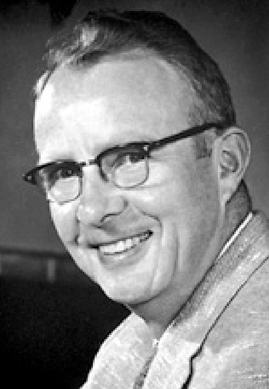
 Luis Walter Alvarez (born 13.06.1911) was an American experimental physicist and a member of the National Academy of Sciences (1947). Born in San Francisco. He graduated from the University of Chicago (1932) and from 1936 worked at the University of California (professor from 1945); in 1954-59 and in 1976-78 he was deputy director of the E. O. Lawrence Radiation Laboratory (Berkeley). His research concerned atomic and nuclear physics, the physics of elementary particles and of cosmic rays, accelerator technology, radar and optics. In 1937 he discovered a new type of radioactive transformation — the capture by a nucleus of an electron from the K shell (K-capture). In 1939, using the cyclotron as a kind of high-frequency mass spectrometer, he detected 3He, and in 1940, together with F. Bloch, he measured the magnetic moment of the free neutron. He was the first to accelerate carbon ions (1940), and he proposed a time-of-flight velocity selector. In 1946 he built the first proton linear accelerator with drift tubes. He built the first large bubble chamber for the study of elementary particles and created the modern technique of working with bubble chambers, which made them suitable for the quantitative study of elementary processes. Under his direction hydrogen chambers were developed, and this made it possible to obtain millions of photographs of the interactions of elementary particles. The technique developed by Alvarez made it possible, from 1955 onwards, to carry out a long series of studies of elementary particles, which resulted in the discovery in 1960 of the so-called resonances — short-lived unstable particles. For the discovery of a large number of resonances and for their study he was awarded the Nobel Prize in 1968. In 1956, together with others, he discovered a new elementary particle — the sigma-zero hyperon. He showed experimentally (1955 — 56) that the τ- and θ-mesons have approximately the same masses and lifetimes, which indicates that these particles are identical; he discovered muon catalysis (1956) and the ω-meson (1961). In 1969 he was president of the American Physical Society. The A. Einstein Medal (1961), the National Medal of Science (1964), the A. Michelson Prize (1965) and others.
Alvarez, Luis Walter
Luis Walter Alvarez (born 13.06.1911) was an American experimental physicist and a member of the National Academy of Sciences (1947). Born in San Francisco. He graduated from the University of Chicago (1932) and from 1936 worked at the University of California (professor from 1945); in 1954-59 and in 1976-78 he was deputy director of the E. O. Lawrence Radiation Laboratory (Berkeley). His research concerned atomic and nuclear physics, the physics of elementary particles and of cosmic rays, accelerator technology, radar and optics. In 1937 he discovered a new type of radioactive transformation — the capture by a nucleus of an electron from the K shell (K-capture). In 1939, using the cyclotron as a kind of high-frequency mass spectrometer, he detected 3He, and in 1940, together with F. Bloch, he measured the magnetic moment of the free neutron. He was the first to accelerate carbon ions (1940), and he proposed a time-of-flight velocity selector. In 1946 he built the first proton linear accelerator with drift tubes. He built the first large bubble chamber for the study of elementary particles and created the modern technique of working with bubble chambers, which made them suitable for the quantitative study of elementary processes. Under his direction hydrogen chambers were developed, and this made it possible to obtain millions of photographs of the interactions of elementary particles. The technique developed by Alvarez made it possible, from 1955 onwards, to carry out a long series of studies of elementary particles, which resulted in the discovery in 1960 of the so-called resonances — short-lived unstable particles. For the discovery of a large number of resonances and for their study he was awarded the Nobel Prize in 1968. In 1956, together with others, he discovered a new elementary particle — the sigma-zero hyperon. He showed experimentally (1955 — 56) that the τ- and θ-mesons have approximately the same masses and lifetimes, which indicates that these particles are identical; he discovered muon catalysis (1956) and the ω-meson (1961). In 1969 he was president of the American Physical Society. The A. Einstein Medal (1961), the National Medal of Science (1964), the A. Michelson Prize (1965) and others.