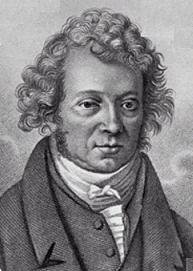
 André-Marie Ampère (22.01.1775 - 10.06.1836) was a French physicist, mathematician and chemist and a member of the Paris Academy of Sciences (1814). Born in Lyon. He was educated at home. In 1805—24 he worked at the École Polytechnique in Paris (professor from 1809), and from 1824 he was professor at the Collège de France. His main work in physics concerned electrodynamics. In 1820 he formulated the rule for determining the direction in which the magnetic field of a current acts on a magnetic needle (Ampère's rule), carried out a large number of experiments on the interaction between an electric current and a magnet, constructing many instruments for the purpose, and detected the influence of the Earth's magnetic field on moving current-carrying conductors. He discovered the interaction of electric currents and established the law of that interaction (Ampère's law), and he developed the theory of magnetism (1820). According to his theory, all magnetic interactions reduce to the interaction of the so-called circular electric molecular currents hidden in bodies, each of which is equivalent to a plane magnet — a magnetic sheet (Ampère's theorem). According to Ampère, a large magnet consists of an enormous number of such elementary plane magnets. Ampère was thus the first to point to the close “genetic” connection between electric and magnetic processes, and he consistently maintained the purely current-based idea of the origin of magnetism. He discovered (1822) the magnetic effect of a coil carrying a current — the solenoid, concluded that a solenoid through which a current flows is the equivalent of a permanent magnet, and put forward the idea of strengthening the magnetic field by placing a core of soft iron inside the solenoid. In 1820 he proposed the use of electromagnetic phenomena for the transmission of signals. He invented the commutator and the electromagnetic telegraph (1829). He formulated the concept of “kinematics”. His research was also in the field of philosophy and botany. A member of many academies of sciences, in particular the St Petersburg Academy of Sciences (1830).
Ampère, André-Marie
André-Marie Ampère (22.01.1775 - 10.06.1836) was a French physicist, mathematician and chemist and a member of the Paris Academy of Sciences (1814). Born in Lyon. He was educated at home. In 1805—24 he worked at the École Polytechnique in Paris (professor from 1809), and from 1824 he was professor at the Collège de France. His main work in physics concerned electrodynamics. In 1820 he formulated the rule for determining the direction in which the magnetic field of a current acts on a magnetic needle (Ampère's rule), carried out a large number of experiments on the interaction between an electric current and a magnet, constructing many instruments for the purpose, and detected the influence of the Earth's magnetic field on moving current-carrying conductors. He discovered the interaction of electric currents and established the law of that interaction (Ampère's law), and he developed the theory of magnetism (1820). According to his theory, all magnetic interactions reduce to the interaction of the so-called circular electric molecular currents hidden in bodies, each of which is equivalent to a plane magnet — a magnetic sheet (Ampère's theorem). According to Ampère, a large magnet consists of an enormous number of such elementary plane magnets. Ampère was thus the first to point to the close “genetic” connection between electric and magnetic processes, and he consistently maintained the purely current-based idea of the origin of magnetism. He discovered (1822) the magnetic effect of a coil carrying a current — the solenoid, concluded that a solenoid through which a current flows is the equivalent of a permanent magnet, and put forward the idea of strengthening the magnetic field by placing a core of soft iron inside the solenoid. In 1820 he proposed the use of electromagnetic phenomena for the transmission of signals. He invented the commutator and the electromagnetic telegraph (1829). He formulated the concept of “kinematics”. His research was also in the field of philosophy and botany. A member of many academies of sciences, in particular the St Petersburg Academy of Sciences (1830).