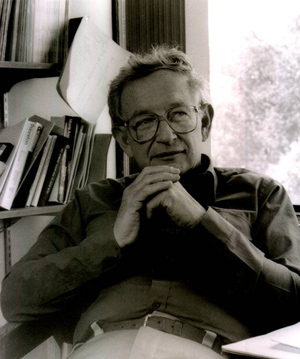
 Philip Warren Anderson (born 13.12.1923) is an American physicist and a member of the National Academy of Sciences (1967). He was born in Indianapolis. He graduated from Harvard University (1943). Since 1949 he has worked at the Bell Telephone Laboratories; in 1967—75 he was visiting professor at the University of Cambridge, and from 1975 professor at Princeton. His research concerned solid-state physics, magnetism, superconductivity, many-body theory, quantum chemistry and nuclear physics. He constructed a quantitative theory of ferrimagnetism (1950), a theory of superconductivity in the language of pseudospin (1958) and a theory of “dirty” superconductors (1959). With the work in which he explained the properties of magnetic impurities in non-magnetic metals he opened a new line of research in the theory of magnetism. In the theory of superconductivity he formulated the theorem that non-magnetic impurities do not affect the temperature at which a metal passes into the superconducting state (Anderson's theorem). An important part was played by his work on the localisation of electronic states in disordered systems and on the phenomenon named the “Anderson transition”. He is one of the creators of the theory of disordered systems. Together with J. Rowell he detected the stationary Josephson effect experimentally in 1963, gave a microscopic theory of the Josephson effects and introduced the term “weak superconductivity”. He made the first superconducting bridges (1964). He constructed a model of the critical currents of type II superconductors with defects (the Anderson—Kim theory). He improved the theory of indirect exchange interaction worked out by H. Kramers (the Kramers—Anderson scheme) and developed the tunnelling-Hamiltonian method. For fundamental theoretical research on the electronic structure of magnetic and disordered systems he was awarded the Nobel Prize in 1977 together with J. Van Vleck and N. Mott. The D. Heineman Prize.
Anderson, Philip Warren
Philip Warren Anderson (born 13.12.1923) is an American physicist and a member of the National Academy of Sciences (1967). He was born in Indianapolis. He graduated from Harvard University (1943). Since 1949 he has worked at the Bell Telephone Laboratories; in 1967—75 he was visiting professor at the University of Cambridge, and from 1975 professor at Princeton. His research concerned solid-state physics, magnetism, superconductivity, many-body theory, quantum chemistry and nuclear physics. He constructed a quantitative theory of ferrimagnetism (1950), a theory of superconductivity in the language of pseudospin (1958) and a theory of “dirty” superconductors (1959). With the work in which he explained the properties of magnetic impurities in non-magnetic metals he opened a new line of research in the theory of magnetism. In the theory of superconductivity he formulated the theorem that non-magnetic impurities do not affect the temperature at which a metal passes into the superconducting state (Anderson's theorem). An important part was played by his work on the localisation of electronic states in disordered systems and on the phenomenon named the “Anderson transition”. He is one of the creators of the theory of disordered systems. Together with J. Rowell he detected the stationary Josephson effect experimentally in 1963, gave a microscopic theory of the Josephson effects and introduced the term “weak superconductivity”. He made the first superconducting bridges (1964). He constructed a model of the critical currents of type II superconductors with defects (the Anderson—Kim theory). He improved the theory of indirect exchange interaction worked out by H. Kramers (the Kramers—Anderson scheme) and developed the tunnelling-Hamiltonian method. For fundamental theoretical research on the electronic structure of magnetic and disordered systems he was awarded the Nobel Prize in 1977 together with J. Van Vleck and N. Mott. The D. Heineman Prize.