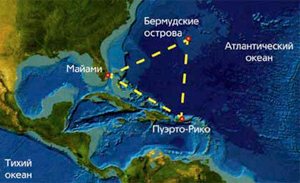
For many decades, the legendary Bermuda Triangle in the Atlantic Ocean has captured the human imagination because of unexplained disappearances of ships, aircraft and people.
Some speculate about unknown and mysterious forces to explain the unexplained disappearances, such as: the abduction of people by aliens for study; the influence of the lost continent of Atlantis; vortices that suck objects into other dimensions, and other fanciful ideas. Some explanations are more scientifically grounded. These include oceanic flatulence ( methane gas is released from ocean sediments ) and disturbs in geomagnetic lines of force.
Environmental conditions could explain many (if not most) of the disappearances. Most Atlantic tropical storms and hurricanes pass through the Bermuda Triangle, and during these periods dangerous storms have carried off many ships. In addition, the Gulf Stream can cause rapid and sharp changes of weather. Also, the many islands in the Caribbean Sea create areas of shallow water, which can be treacherous for vessels. There is some reason to suppose that the Bermuda Triangle is a place where a compass sometimes points to “true” north, as distinct from "magnetic" north.
The US Navy and the US Coast Guard maintain that there are no supernatural explanations for disasters at sea. Their experience shows that a combination of natural phenomena and human errors can outdo even the most improbable science fiction. They add that no official maps of the location of the boundaries of the Bermuda Triangle exist. The US Board on Geographic Names does not recognise the Bermuda Triangle as an official name.
The ocean has always been a mysterious place for man, and when bad weather strikes or navigation fails, it can be very dangerous. This is true all over the world. There is no evidence that mysterious disappearances happen more often in the Bermuda Triangle than in any other place in the ocean.
Although the myth of the Bermuda Triangle was finally debunked over many decades, it still looks like an “insoluble riddle” in new books - whose authors are, for the most part, more interested in a sensational story than in facts.