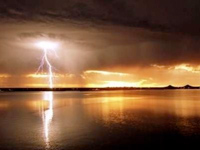
Over the wetlands in the south-western part of Lake Maracaibo an unforgettable sight can be seen: a powerful and almost continuous thunderstorm, with up to 20000 lightning flashes in a night. This is the famous Catatumbo lightning - the most continuous thunderstorm in the world. It is not known for certain when the Maracaibo lightning began, but the phenomenon has become part of the stories of the indigenous peoples.
Catatumbo lightning was well described by the noted naturalists Alexander von Humboldt and the Italian geographer Agustín Codazzi, who described it as a continuous flash emanating from the vicinity of the Zulia River.
In the 20th century and at the beginning of the 21st, other scientists investigated the mechanism of the Catatumbo lightning. Melchor Bravo Centeno suggested in 1911 that Catatumbo lightning arises as a result of the wind regime specific to the region and the features of the terrain. The Venezuelan scientist of Russian origin Andrei Zavrotsky ( organised three expeditions in 1966 - 1970) identified three epicentres of the Catatumbo lightning: in the swamp of the Juan Manuel de Aguas National Park, in Claras Aguas Negras, and at a place to the west of the lake. At that time many believed that the lightning was caused by the evaporation of oil, but Zavrotsky refuted this version, since in two of the three places he had named as epicentres there was no oil.
The expeditions of Nelson Falcón and other scientists led to one more hypothesis: a pyroelectric mechanism. It assumes that the winds over the Maracaibo plains collect methane, which feeds the charges of the lightning. But there are many regions in the world where the concentration of methane in the air is much higher, yet no such phenomenon is observed.
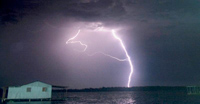
On 27 September 2005 Catatumbo lightning was declared a natural heritage object of Zulia. It was also included in the UNESCO World Heritage Tentative List. Venezuelans note with regret that UNESCO experts do not understand that there may be weather phenomena tied to a particular locality.
In January 2010 an unusual event occurred: the Catatumbo lightning disappeared. The lightning could not be seen, and darkness hung over Lake Maracaibo. But detailed studies showed that the discharge process continued, and the lightning was simply not available to observation with the naked eye. Most probably the cause of the stoppage was an unusual drought in Venezuela. Catatumbo lightning resumed in April 2010, after more than 2 months of "holiday". Before that, Catatumbo lightning had disappeared only for three weeks in 1906, after a tsunami caused by a catastrophic earthquake of magnitude 8.8.
The lightning is observed in the area between 8°30 ` and 9°45 north latitude and 71 ° and 73 ° west longitude, in the state of Zulia, Venezuela. Unlike ordinary thunderstorms, Catatumbo lightning always occurs in the same place and can be observed on 140 - 160 nights a year, for 10 hours each.
The storm begins about an hour after sunset. It is very intense: 20000 flashes can be observed in one night. The discharges have a current of more than 400 000 A each.
The storm takes place in gigantic thunderclouds in the foothills of the mountain. The Maracaibo plain is often free of clouds at night. Boats can go out onto Lake Maracaibo at night, and passengers can enjoy this beautiful natural phenomenon. Thanks to the clear sky, the lightning is visible from afar in the Caribbean Sea, even from a distance of 500 km. Hence the phenomenon's second name, the Maracaibo Lighthouse. It is unlikely that a person could build a lighthouse brighter than this one.
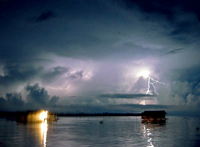
The lightning is often orange and red. Thunder is heard rarely and from a distance. Some researchers ( and many journalists and tour operators ) believe that these features are due to the specific chemistry of the area or to other, even mysterious, features unique to Catatumbo. In fact this is ordinary lightning; the clear sky over Lake Maracaibo simply allows one to see very far, as the storm takes place some 50 - 100 km from the lake. The sound of thunder is lost at such a distance; sounds are rarely audible at a distance of more than 25 kilometres. The orange and red colour of the lightning is also caused by the great distance and by particles of dust and vapour in the atmosphere. The great distance makes it possible to see mainly the electrical discharges between different parts of the thundercloud, and because of this many believe that Catatumbo lightning does not strike the ground. This is also not true - and in this respect it is no different from ordinary thunderstorms.
Scientific research on Catatumbo lightning continues to this day, and new explanations of it appear. But most probably it was already explained in 1911. The key to this unique landmark most probably lies in the interaction of the unique local topography, wind and heat.
High mountains surround the Maracaibo plain on three sides. A specific wind ( low-level air currents ) blows from the only side that is free of mountains, the north-east. The hot tropical sun heats the lake and the swamps during the day; the evaporation warms and humidifies the air.
To the south-west of the plain the wind meets high mountains. The electrically charged masses of humid and hot air are forced to rise here. Condensed vapours form thunderclouds, and an electrical discharge begins.
By some estimates, the Maracaibo lightning produces about 10% of the world's tropospheric ozone.
The disappearance of the Catatumbo lightning in 2010 was an alarming sign: something, it seems, is changing in the local climate. Most probably part of the blame lies with deforestation and the development of agriculture in the area of Lake Maracaibo.