- Electricity and magnetism
- Nuclear physics and elementary particles
- Solid-state physics
- The history of physics
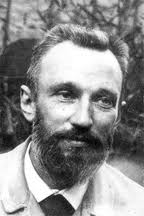 Pierre Curie (15.05.1859-19.04.1906) was a French physicist and one of the founders of the study of radioactivity, and a member of the Paris Academy of Sciences (1905). He was born in Paris. He graduated from the University of Paris (1877), where he worked as an assistant from 1878 to 1883, and in 1883—1904 at the School of Physics and Chemistry (from 1895 — head of a department). In 1895 he married M. Sklodowska. From 1904 he was professor at the University of Paris. He died tragically in an accident. His research concerned the physics of crystals, magnetism and radioactivity.
In 1880, together with his brother, the mineralogist J. Curie, he discovered the piezoelectric effect, and also the converse effect — the appearance of an elastic strain in a crystal when an electric charge is imparted to it. Using the piezoelectric effect they had discovered, they constructed a highly sensitive instrument for measuring small quantities of electricity and weak currents. In 1884—85 he developed the theory of the formation of crystals and studied the laws of symmetry in them; in particular he was the first to introduce (1885) the concept of the surface energy of the faces of a crystal and to formulate a general principle of the growth of crystals. He also proposed (1894) a principle making it possible to determine the symmetry of a crystal that is subjected to some action (the Curie principle). He carried out studies of the magnetic properties of bodies over a wide range of temperatures. In 1895 he established that the magnetic susceptibility of diamagnets is independent of temperature and that for paramagnets it is inversely proportional to temperature (Curie's law). He discovered that for iron there is a temperature above which its ferromagnetic properties disappear (the Curie point) and some other properties, for example the electrical conductivity and the heat capacity, change abruptly (1895).
From 1897 P. Curie's scientific interests were concentrated on the study of radioactivity, in which, together with M. Sklodowska-Curie, he made a number of outstanding discoveries. In 1898 they discovered new radioactive elements — polonium and radium; in 1899 they discovered induced radioactivity and established the complex character of radioactive radiation and its properties. In 1901 Curie detected the biological action of radioactive radiation, and in 1903 he discovered the quantitative law of the decrease of radioactivity, introducing the concept of the half-life, and showed that it is independent of external conditions. Starting from this, he proposed using the half-life as a standard of time for establishing the absolute age of the rocks of the Earth. In the same year, together with A. Laborde, he detected the spontaneous release of heat by radium salts, which was the first visible evidence of the existence of atomic energy. He put forward the hypothesis of radioactive decay. He organised the industrial extraction of radium on the basis of the technology he had developed for obtaining radium from uranium ore.
For their research on radioactivity and their discovery of radium, P. Curie and M. Sklodowska-Curie (together with A. Becquerel) were awarded the Nobel Prize in 1903. The H. Davy Medal (1903). The artificial chemical element curium is named in honour of Pierre and Marie Curie.