 AIM OF THE EXPERIMENT: To charge an object with static electricity.
MATERIALS: scissors, a paper napkin, a ruler, a comb. METHOD: Measure and cut a strip of paper from the napkin (7 cm x 25 cm).
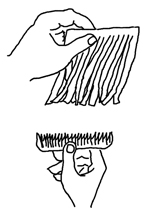
Cut long thin strips in the paper, LEAVING the edge untouched (as in the picture).
Comb your hair quickly. Your hair must be clean and dry. Bring the comb close to the paper strips, but do not touch them.
RESULTS: The paper strips reach towards the comb.
WHY? “Static” means motionless. Static electricity is negative particles, called electrons, gathered together. Matter consists of atoms, in which electrons circle round a positive centre — the nucleus. When we comb our hair, the electrons are, as it were, rubbed off the hair and land on the comb. The half of the comb that touched your hair has acquired a negative charge. A paper strip consists of atoms. We bring the comb up to them, and the positive part of the atoms is attracted to the comb. This attraction between the positive and the negative particles is enough to lift the paper strips up.