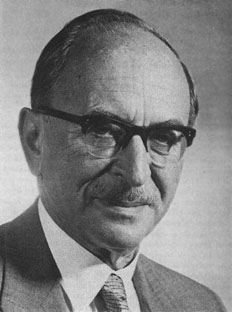
 Dennis Gabor (5.06.1900-9.02.1979) was a physicist and the creator of holography. He was born in Budapest. He studied at the Technical University in Budapest (1918-20). In 1927-33 he worked in Berlin as a research engineer, in 1934—48 in the research laboratory of the British Thomson-Houston Company, and in 1949 — 67 at the University of London (professor from 1958).
His research concerned electron optics, electron microscopy, high-speed oscillography, discharges in gases, plasma physics and communications engineering. In 1948 he published the first papers in which he developed the principles of holography and described experiments on obtaining flat holograms in the light of a mercury lamp. That year is taken as the year of the invention of holography — a fundamentally new method of obtaining three-dimensional images of objects, based on the use of the interference of light. While refining the holographic method he invented the quadrature hologram in 1956 and (together with G. Stroke) removed the shortcomings of his first arrangement, discovering the reversibility of the hologram. For the invention of holography he was awarded the Nobel Prize in 1971. He created the flat cathode-ray tube, developed a matrix theory of the formation of an optical image, a theory of the analytic signal in communications engineering and the principles of pulse compression, and in information theory he formulated the Gabor — Shannon theorem. His last research concerned pictorial holography, and in particular the creation of three-dimensional cinema using holographic principles.
He was the author of many inventions. A member of the Hungarian Academy of Sciences (1964), a Fellow of the Royal Society (1956) and a member of the National Academy of Sciences of the USA (1973). The D. Hughes Medal (1967), the A. Michelson Medal (1968) and the B. Rumford Medal (1968).