AIM OF THE EXPERIMENT: To find out how the weight of a paper helicopter affects its speed of rotation.
MATERIALS: paper (from an exercise book), scissors, a ruler, a pencil, three paper clips.
MATERIALS: paper (from an exercise book), scissors, a ruler, a pencil, three paper clips.
Изображение
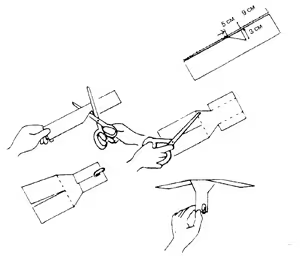
Fold one sheet and cut it in half lengthways.
Fold one of the halves lengthways.
With the ruler and the pencil, draw a right-angled triangle on the folded half. One side of the right angle is 5 cm long and lies on the edge of the folded half, 9 cm from its end, while the other, 3 cm long, runs at right angles to the first towards the fold (see the picture).
Cut the triangle out through both layers of paper at once.
Unfold the sheet and cut up to the point shown in the picture. This gives two wings.
Fold both of the flaps that run from the triangle to the end of the sheet in towards the centre, and clip them underneath with a paper clip.
Bend the wings — one one way and the other the other way.
Hold the helicopter above your head and let it go.
Add more paper clips and launch the helicopter again each time.
RESULTS: As the weight increases the speed of rotation grows up to a certain point, but then, when the load has been increased to a certain value, the added weight pulls the helicopter down so strongly that the wings straighten out and it falls like any other object.
WHY? When a paper helicopter falls, the air escapes from under its wings in all directions. The air flow presses on the helicopter's wings and the helicopter turns. When the weight of the load is increased, the helicopter falls faster, so the air flow acts on it more strongly and the speed of rotation grows. METHOD: