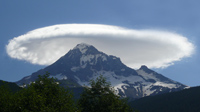
Lenticular (also lens-shaped) clouds are a unique natural phenomenon. These clouds usually form around hills and mountains. They look quite peculiar, resembling giant flying saucers or a stack of pancakes. Many famous mountains around the world have often been photographed with a cap of these clouds, among them Mount Shasta and Mount Fuji.
Lenticular clouds form when a stream of moist air rushes upward as it flows around a mountain, leading to the condensation of moisture and the formation of a cloud.
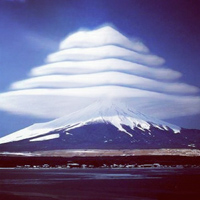 Lens-shaped clouds look completely motionless, as if frozen in time. In fact this is not so. The clouds seem motionless because the stream of moist air constantly replenishes the cloud on the windward side, while moisture evaporates and disappears on the leeward side, leaving the clouds with their characteristic lens shape. Depending on the strength of the air flow and the available moisture, the wave in the air flow can create several lenticular clouds piled on top of one another, like plates. These clouds can be seen hovering for several hours or days, until winds or a change in the weather come and disperse them.
Lens-shaped clouds form at high altitude, between 2000 and 7000 metres. They require a climate with steady, moist, fast-moving winds to create the necessary wave in the atmosphere.
Lenticular clouds are most common in regions with strong winds and high mountains. Lens-shaped clouds can also appear near the raised edges of plateaus or over high hills, and sometimes near tall thunderclouds. They have been photographed on every continent of the world, including Antarctica.
Aeroplane pilots try to keep away from lens-shaped clouds to avoid turbulence, while hang-glider pilots deliberately fly towards them in order to catch the air current for several kilometres.