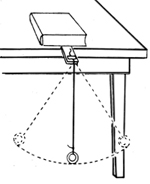
 AIM OF THE EXPERIMENT: To establish how the length of a pendulum affects the time of a single swing.
MATERIALS: string, a washer, scissors, a ruler, sticky tape, a table, a heavy book, a stopwatch or a watch with a second hand, a helper.
METHOD: Cut a piece of string as long as the distance from the floor to the table top.
Tie the washer to one end of the string and tape the other end to the ruler.
Lay the ruler on the table so that it projects ten centimetres beyond the edge and the string hangs freely.
Put the book on the ruler.
Pull the washer to one side and let it go.
Ask your helper to take the time, and count how many oscillations occur in ten seconds.
Shorten the string, leaving a quarter of its former length.
Pull the washer to one side again and let it go, then count how many swings the washer makes in ten seconds.
RESULTS: When you shortened the string, the number of swings doubled.
WHY? The relation between the length of a pendulum and the time of each swing is thought to have been discovered by Galileo. Once, in church, he watched a huge chandelier swinging and took the time by his own pulse. Later he discovered that the time of a single swing depends on the length of the pendulum — the time halves if the pendulum is shortened by three quarters.