V.L. Andreev
E – mail: avl130740@yandex.ru
“The process of scientific discovery is, in essence, a continual flight from wonder”.
A. Einstein
After it was established experimentally at the beginning of the 20th century that the atom is not an elementary particle, quite a few attempts were made to create a physical model of it. However, the matter proved so complicated that physical science was forced to abandon the physical model and replace it with a mathematical one – the very complicated mathematical apparatus of wave mechanics, which makes it possible to obtain practically useful results in atomic physics.
The physical model of the atom that I propose is also an attempt to understand why, as soon as fundamental problems are concerned, physical science prefers not the truth but its reflection.
1. Suppose there is a mechanical system in which a material point (particle) of mass m moves with velocity v from position a to position b, the distance between which along the trajectory is l. We call the completed transition of the material point an event, and among its characteristics we count: the extent in space l, the duration in time T and the action D, numerically equal to the product of the distance l and the momentum of the material point mv:
Изображение

or, in a more general form:
Изображение

Изображение

The physical quantity has the dimension of a product of energy and time, so the energy of the stated event is equal to:
2. If in a mechanical system a certain set of motions of a material point makes up a circuit within a known interval of time T, such a mechanical system is conventionally called cyclic. For example, a linear harmonic oscillator and the planetary model of the Bohr atom are cyclic mechanical systems. The cycle of the planetary model of the hydrogen atom is one event: a complete revolution of the electron around the nucleus along its orbital trajectory. The cycle of the linear harmonic oscillator consists of four events: two events – movements of the material point from the equilibrium position to the positions of extreme displacement; two more – the return of the material point to the equilibrium position.
3. Suppose there exists a cyclic mechanical system whose main feature is that all the events occurring in it under the influence of intra-system forces have the same magnitude of action D, equal to the value of the cyclic Planck constant ħ:
Изображение

A mechanical system in which the motions of a material point satisfy equation (3) we shall call quantum-mechanical.
Since in the supposed quantum-mechanical system the action of each event is constant and equal to D = ħ > 0, it follows necessarily that the cycles in such a system repeat for as long as one likes, and consequently the supposed quantum-mechanical system is a perpetuum mobile, i.e. something eternally moving.
Equation (3), as can be seen, expresses the principle of construction of a perpetuum mobile, and it also asserts that the regularity of this principle is due exclusively to the nature of the intra-system interactions, since it contains no individual features of the particles that make up the quantum-mechanical system.
4. From the logic of equation (3) it follows that in quantum-mechanical systems the nature of the interactions is such that, under the action of the forces arising in the system, the extent of any cyclic event in space l and the momentum of the material point mv stand in the relation:
Изображение

Consequently, if it is reliably established of some mechanical system that it is quantum-mechanical, i.e. that it is a perpetuum mobile, then from this fact it follows necessarily that, regardless of the individual qualities of the particles, their intra-system interactions obey the quantum-mechanical law (4).
5. The idea of a perpetuum mobile does not arise by chance. Our Universe has existed for billions of years. If one proceeds from the position that the unity of the world consists in its materiality, then the atoms that compose it have also existed for billions of years. Consequently, during these same billions of years electrons have been moving in atoms, requiring for their motion no supply of any energy from outside the atom. The energetic self-sufficiency of atoms objectively shows that in atoms electrons move without expenditure of energy, and therefore every atom is objectively a mechanical system of the perpetuum mobile kind. By this empirical fact the quantum-mechanical systems of our supposition become an objective reality: every atom, being objectively a perpetuum mobile, is necessarily a quantum-mechanical system in which each particle performs motions in accordance with equation (4). Therefore for each electron in an atom the relation holds
5. The idea of a perpetuum mobile does not arise by chance. Our Universe has existed for billions of years. If one proceeds from the position that the unity of the world consists in its materiality, then the atoms that compose it have also existed for billions of years. Consequently, during these same billions of years electrons have been moving in atoms, requiring for their motion no supply of any energy from outside the atom. The energetic self-sufficiency of atoms objectively shows that in atoms electrons move without expenditure of energy, and therefore every atom is objectively a mechanical system of the perpetuum mobile kind. By this empirical fact the quantum-mechanical systems of our supposition become an objective reality: every atom, being objectively a perpetuum mobile, is necessarily a quantum-mechanical system in which each particle performs motions in accordance with equation (4). Therefore for each electron in an atom the relation holds
Изображение

and for the nucleus of each atom, the relation
Изображение

6. From the equation of motion (5) it follows that as the velocity of the electron decreases to zero, the extent of the cyclic event in space l increases without limit, i.e. at an electron velocity equal to zero equation (4), which expresses a fundamental law of nature, loses its rational meaning. But the laws of nature are rational with the rationality of being, so if the analysis of an equation expressing some law of nature yields an irrational meaning, this shows a formal approach to the analysis, one that does not take into account the actual physical meaning of this equation.
Without losing its regularity, equation (5) retains a rational meaning only if an electron velocity equal to zero is a sign of a completed cyclic event. But then this sign unambiguously determines also the physical content of the event itself: the electron has made a transition along the trajectory l from position a, in which its momentum was equal to p=mv, to position b, in which its momentum became equal to zero. Since the atom is a perpetuum mobile system, this event cannot be finite, and therefore equation (5) unambiguously determines also the complete cycle of the electron's motion – under the action of the intra-system forces the electron in the atom performs linear oscillations with an amplitude equal to l.
Consequently, equation (5) is an equation of harmonic oscillations from final causes, whose peculiarity is that and in this equation have the meaning not of the current values of the electron's velocity and of the path it has covered, but of final values. Physically this means that if the total kinetic energy of the oscillator is equal to , then the amplitude of its oscillations is necessarily found from equation (5).
7. From the logic of equation (5) it also follows that in the quantum-mechanical systems of the atom the nature of the interactions is such that an increase in the momentum of the electron, caused by the action of one or another external force, necessarily leads to a corresponding “compression” of the trajectory l, and a decrease in momentum to a corresponding “stretching” of it. From this it follows that the forces producing the oscillations of the electron in the atom are not electrostatic, since they do not depend on the position of the electron in the field of the nucleus. These forces depend on the velocity of the electron's motion and the magnitude of its mass, and therefore they are generated by some other physical reality of the atom, which possesses quantum-mechanical properties of interaction with particles. Since we do not know the nature of this new physical reality, we shall call it provisionally the ponderomotive (from Lat. pondus, gen. ponderis – weight, heaviness, and motor – setting in motion) field, and the forces with which this field interacts with particles we shall call ponderomotive. It is precisely through the action of these forces that the oscillations of the electron take place in the atom, and therefore through the action of these forces kinetic energy of the electron is converted into ponderomotive energy of the field and back, which is a necessary condition for the oscillations of the electron to continue over the duration of eternity.
It should be especially emphasised here that the ponderomotive field of the atom is not related by any direct kinship either to the nucleus of the atom or to its electrons. It exists in the atom as a certain selfhood, a special form of materiality, interlayering the potential field of the nucleus.
8. Thus the ponderomotive field and the electron form the system of a quantum linear harmonic oscillator. Since the nature of the acting forces is unknown to us, to describe the motions of the electron we use the kinematic equation of the linear harmonic oscillator, which, as is known, is independent of the acting forces.
The kinematic equation of the linear harmonic oscillator has the form
Изображение

Differentiating (6) with respect to time and multiplying the result by the mass of the oscillator me, we obtain the momentum of the harmonic oscillator
Изображение

In each position, characterised by the displacement q, the oscillator has some value of the momentum p. To find p as a function of q, one must eliminate time from equations (6) and (8). For this we represent these equations in the form:
Изображение
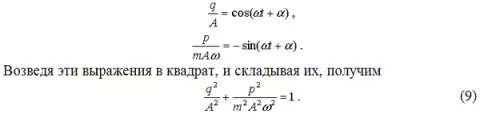
The coordinate plane p,q is called the phase plane, and the graph showing the dependence of the momentum p on the displacement q – the phase trajectory. In accordance with (9) the phase trajectory of a harmonic oscillator is an ellipse with semi-axes A and mAω. Each point of the phase trajectory represents a displacement q and a momentum p, i.e. the state of the oscillator at some moment of time. In the course of time the point representing the state moves along the phase trajectory counter-clockwise, making a complete circuit during one period of oscillation. Therefore the oscillations of a linear harmonic oscillator can be represented in the form of a “frozen” single wave of momentum, whose length is equal to
Изображение

I stress that it is not the electron that is represented here as a “frozen” wave, but the oscillations of the electron that are represented by a wave of momentum in the phase plane, which allows some relations of the oscillatory process to be expressed more clearly.
We now find the area of the ellipse. The area of the ellipse S, as is known, is equal to the product of the semi-axes of the ellipse multiplied by π:
We now find the area of the ellipse. The area of the ellipse S, as is known, is equal to the product of the semi-axes of the ellipse multiplied by π:
Изображение
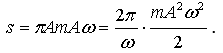
In the oscillation equation written by the method of the rotating amplitude vector, the expression mA2ω20/2 is the total energy of the oscillator W, the quantity 2π/ω is equal to 1/ν, so the area of the ellipse can be represented in the form
Изображение
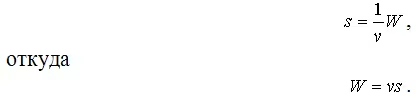
Thus the energy of a harmonic oscillator is proportional to the area of the ellipse S, and the coefficient of proportionality is the natural frequency of the oscillator. The area of the ellipse can also be calculated as a contour integral
Изображение
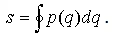
In the phase plane the area of the ellipse has the dimension of action. According to the extremal principle of Maupertuis, when a mechanical system moves between two of its positions, its true, i.e. actually occurring, motion differs from all possible motions in that for it the value of the action S is the least:
Изображение
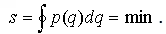
But the minimum value of the action S does not mean an infinitesimal value. Taking, like Planck,
S = h
we obtain the expression for the total energy of the linear harmonic oscillator, which is now quantum
S = h
we obtain the expression for the total energy of the linear harmonic oscillator, which is now quantum
Изображение

Substituting into equation (7) the value A=l, the value of ω , found from equation (11), and the value of the phase α, found by applying equation (10),
Изображение

and taking into account that in quantum mechanics the exponent is customarily taken with a minus sign, we obtain the desired equation of the quantum linear harmonic oscillator
Изображение

where Ψ is the identifier of the system of the quantum oscillator, in the unity of the ponderomotive field and the electron of the atom.
9. We now consider the influence of the electrostatic field of the nucleus on the quantum harmonic oscillator. The electrostatic field does not act directly on the ponderomotive field; its action is mediated by Coulomb forces. Coulomb forces decrease by the inverse-square law, and therefore their action depends nonlinearly on the position of the electron in the field of the nucleus, and so the quantum oscillator necessarily becomes anharmonic: the amplitude of the electron's oscillations in the direction of the nucleus becomes smaller than the amplitude of oscillations in the direction opposite to the nucleus.
Since the motions of electrons in an atom are not accessible to direct observation and the nature of the ponderomotive field is unknown to us, to derive the equation of the anharmonic quantum oscillator we use the equation of motion of the electron from the law of conservation of energy.
Taking the ponderomotive field into account, the total energy of the electron in the electrostatic field of the atomic nucleus is equal to the sum of its kinetic and mediated ponderomotive energies:
Изображение
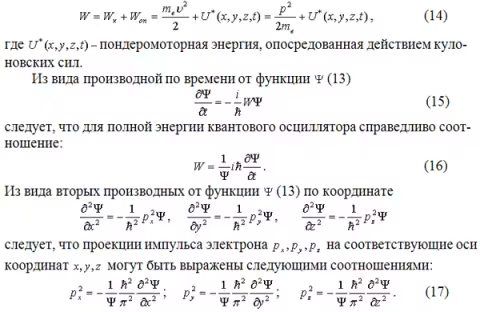
Substituting into (14) the value of the energy and of the momentum p2 = p2x + p2y + p2z from (16) and (17) respectively, we obtain the desired equation of the anharmonic quantum oscillator
Изображение
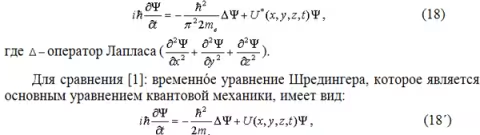
where, as is known:
– Ψ is some wave function, in essence a mathematical form, about which one can expediently think something but which is not physically realised;
– U(x,y,z,t) is only the potential energy of the electron in the field of the nucleus;
– the absence of the factor 1/π2is due to the fact that in determining the phase α Schrödinger used the de Broglie wave, whose length λ is related to the single wave of momentum λp by the relation: λ = λpπ/2.
However, despite these differences, one must necessarily admit that the basic equation of quantum mechanics is an equation of a quantum oscillator, and it is this circumstance that accounts for its “magical” fruitfulness in atomic physics. Since this equation is not exact, in its experimental tests good agreement of the solutions of the equation with the results of experiment is achieved by expedient “fantasies” about the Ψ-function and the specific properties of electrons in the atom.