V.M.Yurovitsky, Moscow
Humanity's entry into space compels a fresh interpretation of many mechanical concepts.
One of the central discoveries was the phenomenon of weightlessness. Classical mechanics knew no such phenomenon. Suffice it to say that the term “weightlessness” appeared in encyclopaedias and encyclopaedic dictionaries only in the middle of the nineteen-sixties. Although the first anticipations of the existence of this phenomenon are found in K.E.Tsiolkovsky[1].
The phenomenon of weightlessness plays a most important role in cosmonautics. And the absence of this phenomenon from classical Newtonian mechanics suggests that it is inadequate to the new needs of scientific and technical development and compels a fresh examination of the foundations of mechanics.
But other phenomena are also known that directly contradict Newtonian mechanics, and to save it one has to alter literally the foundations of the universe as it took shape over centuries and even millennia. Such, for example, is the situation with the motion of stars in a galaxy. According to Newtonian theory, the speed of the orbital motion of stars around the centre of a galaxy should fall with distance from the centre (as in the Solar System), but reality turns out to be radically different – the speed of the stars increases with distance from the centre of the galaxy. The absolute impossibility of reconciling this result with the theory gave rise to a notion that in principle destroys the very foundations of the scientific approach ─ the notion of so-called “hidden masses”. For if at every contradiction between reality and our theories we use the concept of “hidden factors”, then science simply disappears. What remains is a kind of pseudoscientific shamanism.
Other examples of discrepancies between experimental data and Newtonian mechanics can also be given; they were reflected especially clearly in the sphere of practical cosmonautics and have had, and often still have, an unfavourable effect on this sphere of activity itself, important now and likely to become the most important in the future.
Thus an analysis of the foundations of mechanics in the light of the most recent experience of the development of civilisation appears urgently necessary.
1. The inertial frame of reference and Newton's First Law
As is well known, Newton's First Law states that free bodies, i.e. bodies to which no forces are applied, move uniformly and in a straight line or are at rest in an inertial frame of reference.
For completeness, a definition of an inertial frame of reference would have to be given. Unfortunately, Newton did not give this definition. For centuries mechanicians tried to define inertial frames of reference. The definition given by Wikipedia can be considered the apotheosis of this research: “Inertial frame of reference (IFR) — a frame of reference in which Newton's first law holds”[2]. In other words, everything came down to a vicious circle: the first law holds in an IFR, an IFR – a frame of reference in which Newton's first law holds.
It is clear that it is impermissible to build “big mechanics” on such a logical foundation.
2. Weightiness ─ a new mechanical characteristic
Cosmonautics has brought to the fore a new concept of mechanics – the concept of the mechanical state, which is absent from modern mechanics.
We postulate such a concept and assume that there are two main types of mechanical state ─ the weighty and the weightless. And for a quantitative characterisation of mechanical states we introduce a new fundamental mechanical characteristic, which we shall call “weightiness”. Because it is fundamental, it has no definition in mechanics. But we can indicate the ways of measuring it in practice. These instruments are well known and widely used, although at present they are called, hardly correctly, ─ “accelerometers” and “gravimeters”. It would be correct to call them “weightiness meters”. Weightiness is measured directly on the body itself and is not a kinematic characteristic. This characteristic is connected with present-day mechanics through the LAW OF THE MECHANICAL STATE. This law has the form:
Humanity's entry into space compels a fresh interpretation of many mechanical concepts.
One of the central discoveries was the phenomenon of weightlessness. Classical mechanics knew no such phenomenon. Suffice it to say that the term “weightlessness” appeared in encyclopaedias and encyclopaedic dictionaries only in the middle of the nineteen-sixties. Although the first anticipations of the existence of this phenomenon are found in K.E.Tsiolkovsky[1].
The phenomenon of weightlessness plays a most important role in cosmonautics. And the absence of this phenomenon from classical Newtonian mechanics suggests that it is inadequate to the new needs of scientific and technical development and compels a fresh examination of the foundations of mechanics.
But other phenomena are also known that directly contradict Newtonian mechanics, and to save it one has to alter literally the foundations of the universe as it took shape over centuries and even millennia. Such, for example, is the situation with the motion of stars in a galaxy. According to Newtonian theory, the speed of the orbital motion of stars around the centre of a galaxy should fall with distance from the centre (as in the Solar System), but reality turns out to be radically different – the speed of the stars increases with distance from the centre of the galaxy. The absolute impossibility of reconciling this result with the theory gave rise to a notion that in principle destroys the very foundations of the scientific approach ─ the notion of so-called “hidden masses”. For if at every contradiction between reality and our theories we use the concept of “hidden factors”, then science simply disappears. What remains is a kind of pseudoscientific shamanism.
Other examples of discrepancies between experimental data and Newtonian mechanics can also be given; they were reflected especially clearly in the sphere of practical cosmonautics and have had, and often still have, an unfavourable effect on this sphere of activity itself, important now and likely to become the most important in the future.
Thus an analysis of the foundations of mechanics in the light of the most recent experience of the development of civilisation appears urgently necessary.
1. The inertial frame of reference and Newton's First Law
As is well known, Newton's First Law states that free bodies, i.e. bodies to which no forces are applied, move uniformly and in a straight line or are at rest in an inertial frame of reference.
For completeness, a definition of an inertial frame of reference would have to be given. Unfortunately, Newton did not give this definition. For centuries mechanicians tried to define inertial frames of reference. The definition given by Wikipedia can be considered the apotheosis of this research: “Inertial frame of reference (IFR) — a frame of reference in which Newton's first law holds”[2]. In other words, everything came down to a vicious circle: the first law holds in an IFR, an IFR – a frame of reference in which Newton's first law holds.
It is clear that it is impermissible to build “big mechanics” on such a logical foundation.
2. Weightiness ─ a new mechanical characteristic
Cosmonautics has brought to the fore a new concept of mechanics – the concept of the mechanical state, which is absent from modern mechanics.
We postulate such a concept and assume that there are two main types of mechanical state ─ the weighty and the weightless. And for a quantitative characterisation of mechanical states we introduce a new fundamental mechanical characteristic, which we shall call “weightiness”. Because it is fundamental, it has no definition in mechanics. But we can indicate the ways of measuring it in practice. These instruments are well known and widely used, although at present they are called, hardly correctly, ─ “accelerometers” and “gravimeters”. It would be correct to call them “weightiness meters”. Weightiness is measured directly on the body itself and is not a kinematic characteristic. This characteristic is connected with present-day mechanics through the LAW OF THE MECHANICAL STATE. This law has the form:
Изображение

Hence the dimension of weightiness in the SI is newton per kilogram (N/kg). It is proposed to give this characteristic the name “Galileo” (Gl). All the more so since one hundredth of this quantity is the basic unit in gravimetry and is called the “gal”. Then normal terrestrial weightiness will be 9.81 Gl. The weightiness of a spacecraft during launch is of the order of 40 Gl, and in flight of the order of 1 mGl (microgravity). In an isotope-separation centrifuge the weightiness reaches 1 MGl. Note that the direction of the weightiness vector is opposite to the direction of the applied force.
Weightiness characterises the reaction, the action of the body on the source of the force, i.e. it is connected precisely with weight.
Weightlessness is in fact a synonym for the concept of “freedom”. A weighty body is not free, a weighty one ─ is free.
3. Frames of reference in classical mechanics
Various frames of reference are used in physics. In classical mechanics, frames of reference based on the image of a rigid body are used. A system of reference bodies in this representation is a perfectly rigid body whose reference elements are fastened together by absolutely rigid links. Metals, diamond and the like can serve as an image of a perfectly rigid body. It is postulated that the distances between any elements of the rigid body are unchanging.
For a complete description of a frame of reference the concept of a straight line must also be defined. In modern practice two definitions of the straight line are used: the straight line as the image of a taut thread, and the straight line as the image of the line of motion of light.
To a first approximation these two concepts of the straight line coincide. In terrestrial practice, for example in geodesy, both representations are used. On astronomical scales, however, these images diverge. And a choice has to be made. We consider that the preferable variant is the taut thread as the image of the straight line. As to whether the line of motion of light is straight or curved, that should be decided in specific conditions.
To determine a spatial scale, a segment of a straight line between two chosen elements of the rigid body is defined as the standard of length. This makes it possible to create the metric of space and a three-dimensional coordinate system.
To measure time we can use various periodic processes, such as the oscillations of a gravitational pendulum, spring clocks, atomic clocks and so on. To determine the stability of the measurement the following method can be proposed: two identical clocks are made. They are synchronised. One clock is left motionless in the frame of reference, while the second is subjected to various mechanical and kinematic influences. If after some time the clocks are brought together and remain synchronous, then we can recognise these clocks as sufficiently steady and stable, and they can be used as coordinate clocks ─ clocks coupled to the elements of the frame of reference.
It is evident that the metric created in this way is universal and uniform for the whole of space and depends neither on what fills it nor on the processes going on in it. Our opinion is that the metric of space is created and is not a law of nature. And an achievement of modern civilisation consists in the use of uniform standards and measures in all regions of space ─ the unity of metrology. That is why the notion that metrology depends on what fills space seems to us entirely unacceptable from the point of view of modern metrological science and scientific and technical development.
4. Inertial frames of reference
The elements of a frame of reference based on a rigid body, in order to keep their immobility, are as a rule connected with one another by force links and therefore are in a weighty state. For example, in a rotating frame of reference we have weighty reference bodies whose weightiness is
W = ω2ρ,
ρ ─ the distance to the axis of rotation. The elements of rigid frames of reference in gravitational space are also weighty. For example, in a rigid non-rotating frame of reference with a single massive body we have a weightiness decreasing with radius, equal to
Weightiness characterises the reaction, the action of the body on the source of the force, i.e. it is connected precisely with weight.
Weightlessness is in fact a synonym for the concept of “freedom”. A weighty body is not free, a weighty one ─ is free.
3. Frames of reference in classical mechanics
Various frames of reference are used in physics. In classical mechanics, frames of reference based on the image of a rigid body are used. A system of reference bodies in this representation is a perfectly rigid body whose reference elements are fastened together by absolutely rigid links. Metals, diamond and the like can serve as an image of a perfectly rigid body. It is postulated that the distances between any elements of the rigid body are unchanging.
For a complete description of a frame of reference the concept of a straight line must also be defined. In modern practice two definitions of the straight line are used: the straight line as the image of a taut thread, and the straight line as the image of the line of motion of light.
To a first approximation these two concepts of the straight line coincide. In terrestrial practice, for example in geodesy, both representations are used. On astronomical scales, however, these images diverge. And a choice has to be made. We consider that the preferable variant is the taut thread as the image of the straight line. As to whether the line of motion of light is straight or curved, that should be decided in specific conditions.
To determine a spatial scale, a segment of a straight line between two chosen elements of the rigid body is defined as the standard of length. This makes it possible to create the metric of space and a three-dimensional coordinate system.
To measure time we can use various periodic processes, such as the oscillations of a gravitational pendulum, spring clocks, atomic clocks and so on. To determine the stability of the measurement the following method can be proposed: two identical clocks are made. They are synchronised. One clock is left motionless in the frame of reference, while the second is subjected to various mechanical and kinematic influences. If after some time the clocks are brought together and remain synchronous, then we can recognise these clocks as sufficiently steady and stable, and they can be used as coordinate clocks ─ clocks coupled to the elements of the frame of reference.
It is evident that the metric created in this way is universal and uniform for the whole of space and depends neither on what fills it nor on the processes going on in it. Our opinion is that the metric of space is created and is not a law of nature. And an achievement of modern civilisation consists in the use of uniform standards and measures in all regions of space ─ the unity of metrology. That is why the notion that metrology depends on what fills space seems to us entirely unacceptable from the point of view of modern metrological science and scientific and technical development.
4. Inertial frames of reference
The elements of a frame of reference based on a rigid body, in order to keep their immobility, are as a rule connected with one another by force links and therefore are in a weighty state. For example, in a rotating frame of reference we have weighty reference bodies whose weightiness is
W = ω2ρ,
ρ ─ the distance to the axis of rotation. The elements of rigid frames of reference in gravitational space are also weighty. For example, in a rigid non-rotating frame of reference with a single massive body we have a weightiness decreasing with radius, equal to
Изображение
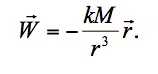
But frames of reference with weightless reference bodies can also exist. We shall call such frames of reference “soft” frames of reference.
And finally, frames of reference are possible that are at once rigid and soft.
In these frames of reference we have reference elements that are motionless relative to one another, but they are weightless, i.e. have no force link with one another.
Such frames of reference are the inertial frames of reference.
Since the reference bodies themselves are weightless, i.e. free, any free bodies that are motionless at some moment of time will remain motionless always. That is, the validity of the first part of Newton's First Law, in an inertial frame of reference defined in this way, concerning the existence of motionless free bodies, we have shown.
Let us now consider a moving free body in our frame of reference. It can move uniformly and in a straight line or in some other way. In the first case we shall say that the body moves with zero acceleration. In the second case we have some accelerated motion.
But acceleration is a vector. And this vector can be directed in any direction relative to the velocity. But for the motion of a free body there is no ground for singling out any direction whatever of this vector. Indeed, such motion has no kinematic characteristics of its own other than the velocity. Nor does the surrounding space, which in an inertial frame of reference is homogeneous and isotropic and devoid of any characteristics of its own, have any. From this it follows that the acceleration of a free body in this frame of reference cannot have a direction and, consequently, must have zero value. And the moving body itself will move uniformly and in a straight line in this frame of reference. Thus Newton's First Law passes from the category of axioms of mechanics with an indefinite status of truth (owing to the indefiniteness of the IFR) into the category of provable statements: a free (weightless) body moves in an inertial frame of reference uniformly and in a straight line or is at rest.
Thus the problem of Newton's First Law is completely solved.
5. The motion of weighty bodies in an inertial frame of reference
So we have given a description of the motion of free (weightless) bodies in an inertial frame of reference, and have in effect confirmed Newton's First Law.
Now the question arises of the motion of weighty bodies in an inertial frame of reference. Obviously such motion must already be accelerated, since otherwise it would be unaccelerated. A body (material point) in a weighty state is characterised by the weightiness vector W→. The magnitude and direction of this vector are measured directly on the body itself by means of an instrument that we have called the “weightiness meter” (an accelerometer in modern terminology). The material point possesses no other vector characteristic. And consequently a functional relation must exist between the acceleration vector w→ and the weightiness vector W→ .
According to Newton's Second Law this relation has a simple linear form:
And finally, frames of reference are possible that are at once rigid and soft.
In these frames of reference we have reference elements that are motionless relative to one another, but they are weightless, i.e. have no force link with one another.
Such frames of reference are the inertial frames of reference.
Since the reference bodies themselves are weightless, i.e. free, any free bodies that are motionless at some moment of time will remain motionless always. That is, the validity of the first part of Newton's First Law, in an inertial frame of reference defined in this way, concerning the existence of motionless free bodies, we have shown.
Let us now consider a moving free body in our frame of reference. It can move uniformly and in a straight line or in some other way. In the first case we shall say that the body moves with zero acceleration. In the second case we have some accelerated motion.
But acceleration is a vector. And this vector can be directed in any direction relative to the velocity. But for the motion of a free body there is no ground for singling out any direction whatever of this vector. Indeed, such motion has no kinematic characteristics of its own other than the velocity. Nor does the surrounding space, which in an inertial frame of reference is homogeneous and isotropic and devoid of any characteristics of its own, have any. From this it follows that the acceleration of a free body in this frame of reference cannot have a direction and, consequently, must have zero value. And the moving body itself will move uniformly and in a straight line in this frame of reference. Thus Newton's First Law passes from the category of axioms of mechanics with an indefinite status of truth (owing to the indefiniteness of the IFR) into the category of provable statements: a free (weightless) body moves in an inertial frame of reference uniformly and in a straight line or is at rest.
Thus the problem of Newton's First Law is completely solved.
5. The motion of weighty bodies in an inertial frame of reference
So we have given a description of the motion of free (weightless) bodies in an inertial frame of reference, and have in effect confirmed Newton's First Law.
Now the question arises of the motion of weighty bodies in an inertial frame of reference. Obviously such motion must already be accelerated, since otherwise it would be unaccelerated. A body (material point) in a weighty state is characterised by the weightiness vector W→. The magnitude and direction of this vector are measured directly on the body itself by means of an instrument that we have called the “weightiness meter” (an accelerometer in modern terminology). The material point possesses no other vector characteristic. And consequently a functional relation must exist between the acceleration vector w→ and the weightiness vector W→ .
According to Newton's Second Law this relation has a simple linear form:
Изображение

Here k is a metrological coefficient determined by the standards and the system of physical units used. In the SI this coefficient equals 1.
Note that this equation is a hypothesis, which is well confirmed for non-relativistic motions. But this equation contradicts the theory of relativity. It admits the speed of light and even superluminal speeds of motion of massive bodies. It therefore requires modernisation and bringing into agreement with the principles of relativism.
Note that the non-relativistic character of Newton's second law was noticed at once. And there were many attempts to “relativise” it, but all of them proved unconvincing, and to this day no satisfactory relativistic formulation of Newton's second law has been found.
But the use of weightiness as the fundamental characteristic makes it possible to propose a fairly logical hypothesis. For this it is only necessary to add to the right-hand side a relativistic factor 1 - v2/c2 raised to some power. The power can be chosen from natural logical conditions: at constant weightiness the limiting motion (as t→∞) is motion at the speed of light. It turns out that only the power 1 meets this condition. With other exponents, limiting values appear for the time of existence of constant weightiness, which contradicts experience ─ the unlimited existence of weighty bodies in a gravitational field. Thus we adopt the relativistic law of motion of weighty bodies in an IFR:
Note that this equation is a hypothesis, which is well confirmed for non-relativistic motions. But this equation contradicts the theory of relativity. It admits the speed of light and even superluminal speeds of motion of massive bodies. It therefore requires modernisation and bringing into agreement with the principles of relativism.
Note that the non-relativistic character of Newton's second law was noticed at once. And there were many attempts to “relativise” it, but all of them proved unconvincing, and to this day no satisfactory relativistic formulation of Newton's second law has been found.
But the use of weightiness as the fundamental characteristic makes it possible to propose a fairly logical hypothesis. For this it is only necessary to add to the right-hand side a relativistic factor 1 - v2/c2 raised to some power. The power can be chosen from natural logical conditions: at constant weightiness the limiting motion (as t→∞) is motion at the speed of light. It turns out that only the power 1 meets this condition. With other exponents, limiting values appear for the time of existence of constant weightiness, which contradicts experience ─ the unlimited existence of weighty bodies in a gravitational field. Thus we adopt the relativistic law of motion of weighty bodies in an IFR:
Изображение

In the spirit of the theory of relativity, at constant weightiness the acceleration decreases as the speed of light is approached, and the speed of the body itself cannot reach the speed of light.
Consider as an example motion with constant weightiness from a motionless initial state:
Consider as an example motion with constant weightiness from a motionless initial state:
Изображение
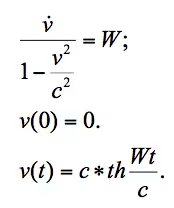
It can be seen that at small times we have classical uniformly accelerated motion:
ν = Wt
At large times the growth of the speed slows down and tends to the speed of light.
So we have obtained (in the form of a hypothesis) the relativistic law of motion of weighty bodies in an inertial frame of reference. Why was it impossible to obtain it in the Newtonian formulation? The point is that force enters the law of motion explicitly. And forces can depend on velocity in the most various ways, having nothing even to do with relativism. In the proposed approach Newton's second law is divided into two parts with different domains of validity. The equation of state has no connection with motion; it is always valid. And the equation of motion has a limited domain of applicability – only in an IFR. In non-inertial frames of reference this law is invalid. In this way we obtain a better-founded mechanics.
6. The law of force interaction
The law of force interaction is Newton's third law:
ν = Wt
At large times the growth of the speed slows down and tends to the speed of light.
So we have obtained (in the form of a hypothesis) the relativistic law of motion of weighty bodies in an inertial frame of reference. Why was it impossible to obtain it in the Newtonian formulation? The point is that force enters the law of motion explicitly. And forces can depend on velocity in the most various ways, having nothing even to do with relativism. In the proposed approach Newton's second law is divided into two parts with different domains of validity. The equation of state has no connection with motion; it is always valid. And the equation of motion has a limited domain of applicability – only in an IFR. In non-inertial frames of reference this law is invalid. In this way we obtain a better-founded mechanics.
6. The law of force interaction
The law of force interaction is Newton's third law:
Изображение

However, the meaning of this law is somewhat different. Without this law, relation (1) is simply a definition of force. Relation (4) gives it the status of a law.
7. Mass
The concept of mass receives much attention in Newtonian mechanics. Two concepts of mass arise there – gravitational and inertial.
Gravitational (gravitating) mass exists in the Newtonian approach as the source of gravitational forces. Inertial mass characterises the measure of the inertia of bodies on the basis of Newton's second law.
In the foundations of mechanics formulated above, mass enters exclusively into the definition of force. And for this definition to make sense, we must define the concept of mass.
We have no inertial mass. But gravitational masses do exist. They enter not into gravitational forces but into the weightiness gravitational field. The intensity of weightiness at a fixed distance from a gravitating body depends on the properties of that body. This property is what we shall define as mass. We shall define mass as an additive characteristic. An increase of the weightiness at a fixed distance by a factor of two we shall attribute to a mass of the gravitating body increased by a factor of two. Thus we finally arrive at a description of mass through the characteristic of the weightiness field of a single gravitating body:
7. Mass
The concept of mass receives much attention in Newtonian mechanics. Two concepts of mass arise there – gravitational and inertial.
Gravitational (gravitating) mass exists in the Newtonian approach as the source of gravitational forces. Inertial mass characterises the measure of the inertia of bodies on the basis of Newton's second law.
In the foundations of mechanics formulated above, mass enters exclusively into the definition of force. And for this definition to make sense, we must define the concept of mass.
We have no inertial mass. But gravitational masses do exist. They enter not into gravitational forces but into the weightiness gravitational field. The intensity of weightiness at a fixed distance from a gravitating body depends on the properties of that body. This property is what we shall define as mass. We shall define mass as an additive characteristic. An increase of the weightiness at a fixed distance by a factor of two we shall attribute to a mass of the gravitating body increased by a factor of two. Thus we finally arrive at a description of mass through the characteristic of the weightiness field of a single gravitating body:
Изображение

Here G ─ is some metrological coefficient determined by the measures and units used. In the SI, with the kg as the unit of mass, G = 6.67384(80)·10−11 m³·s−2·kg−1, or N·m²·kg−2 . Newton's third law makes it possible to check the consistency of the measures and units used
The question of the equivalence of gravitational and inertial mass does not arise, since there is no inertial mass.
7. The Newtonian theory of gravitation
The Newtonian theory of gravitation is based on the concept of gravitational forces and rests on Newton's second law. One can argue whether gravitational forces exist. But that the use of Newton's second law to calculate the motions of bodies in a gravitational field is unjustified ─ this is obvious.
A rigid frame of reference in a gravitational field is not inertial and its use is impermissible. Above we have already described the field of weightiness in a non-inertial frame of reference in the space around a gravitating body (in the frame of reference of that body).
But does it mean that all the results of the Newtonian theory of gravitation are wrong? No, it does not. For, according to the rules of logic, true consequences follow from a true statement, while from a false one both true and false consequences may follow. For example, a human being is a bird. False. But a human being as a bird has two legs ─ a true consequence. Consequently, in the existing gravitational theory both true and false propositions may be present. To sift out the latter, it is necessary to create a different, non-Newtonian gravitational theory. Careful analysis shows that the Newtonian theory gives correct kinematic, but not dynamic, results only in a system of two bodies. For example, the motion of planets around the Sun, of spacecraft around massive celestial bodies, and so on. But in problems of three or more bodies (for example, the Moon, galaxies) this theory leads to incorrect results.
This duality is easily explained on the basis of the principle of kinematic reciprocity. Consider two bodies moving relative to each other in an arbitrary manner, interacting with each other or not. It is easy to show that each of the bodies can be associated with its own, mutual frames of reference in which the motions of the partners will be identical. The motion of body 1 in the frame of reference of body 2 will be identical to the motion of body 2 in the frame of reference of body 1. The states of these bodies play no role in this.
But in a system of three or more bodies, mutual frames of reference are already impossible. It is impossible to create frames of reference associated with each body in which the two other partners would have the same motion in all frames of reference. It is impossible to create frames of reference Si associated with body i such that all the motions sij (the motion of body j in the frame of reference of body i) are equal to the motion sji for any i and j. In such frames of reference it already matters to know the states of each of the bodies and the properties of the frames of reference associated with them.
That is precisely why the state of the bodies (which is defined incorrectly in Newtonian theory) can be neglected in the kinematic problem of two bodies. In problems of three and more bodies it is impermissible and leads to incorrect results. The simplest example is the problem of the Moon.
8. Conclusion
The advent of the space civilisation requires a revision of classical mechanics. In this the seemingly most reliable concepts, with a history of many centuries, turn out to be wrong and in need of reconsideration. A new mechanics requires new concepts. And such a new concept, radically changing the very language of mechanics, is the concept of the mechanical state with the characteristic of weightiness.
On the basis of the new axiomatics of mechanics it is already possible to build the new mechanics itself, which will describe mechanical phenomena and processes more adequately, above all in the realm of the megaworld, i.e. in the sphere of space activity, and further in the realm of stellar, galactic and cosmological scales.
Bibliography:
1. K.E.Tsiolkovsky. “Free Space (a systematic exposition of scientific ideas)”, 1883, published in 1954.
Yurovitsky Vladimir Mikhailovich, Moscow Institute of Technology, orhidectom@yur.ru +7-926-314-9817
The question of the equivalence of gravitational and inertial mass does not arise, since there is no inertial mass.
7. The Newtonian theory of gravitation
The Newtonian theory of gravitation is based on the concept of gravitational forces and rests on Newton's second law. One can argue whether gravitational forces exist. But that the use of Newton's second law to calculate the motions of bodies in a gravitational field is unjustified ─ this is obvious.
A rigid frame of reference in a gravitational field is not inertial and its use is impermissible. Above we have already described the field of weightiness in a non-inertial frame of reference in the space around a gravitating body (in the frame of reference of that body).
But does it mean that all the results of the Newtonian theory of gravitation are wrong? No, it does not. For, according to the rules of logic, true consequences follow from a true statement, while from a false one both true and false consequences may follow. For example, a human being is a bird. False. But a human being as a bird has two legs ─ a true consequence. Consequently, in the existing gravitational theory both true and false propositions may be present. To sift out the latter, it is necessary to create a different, non-Newtonian gravitational theory. Careful analysis shows that the Newtonian theory gives correct kinematic, but not dynamic, results only in a system of two bodies. For example, the motion of planets around the Sun, of spacecraft around massive celestial bodies, and so on. But in problems of three or more bodies (for example, the Moon, galaxies) this theory leads to incorrect results.
This duality is easily explained on the basis of the principle of kinematic reciprocity. Consider two bodies moving relative to each other in an arbitrary manner, interacting with each other or not. It is easy to show that each of the bodies can be associated with its own, mutual frames of reference in which the motions of the partners will be identical. The motion of body 1 in the frame of reference of body 2 will be identical to the motion of body 2 in the frame of reference of body 1. The states of these bodies play no role in this.
But in a system of three or more bodies, mutual frames of reference are already impossible. It is impossible to create frames of reference associated with each body in which the two other partners would have the same motion in all frames of reference. It is impossible to create frames of reference Si associated with body i such that all the motions sij (the motion of body j in the frame of reference of body i) are equal to the motion sji for any i and j. In such frames of reference it already matters to know the states of each of the bodies and the properties of the frames of reference associated with them.
That is precisely why the state of the bodies (which is defined incorrectly in Newtonian theory) can be neglected in the kinematic problem of two bodies. In problems of three and more bodies it is impermissible and leads to incorrect results. The simplest example is the problem of the Moon.
8. Conclusion
The advent of the space civilisation requires a revision of classical mechanics. In this the seemingly most reliable concepts, with a history of many centuries, turn out to be wrong and in need of reconsideration. A new mechanics requires new concepts. And such a new concept, radically changing the very language of mechanics, is the concept of the mechanical state with the characteristic of weightiness.
On the basis of the new axiomatics of mechanics it is already possible to build the new mechanics itself, which will describe mechanical phenomena and processes more adequately, above all in the realm of the megaworld, i.e. in the sphere of space activity, and further in the realm of stellar, galactic and cosmological scales.
Bibliography:
1. K.E.Tsiolkovsky. “Free Space (a systematic exposition of scientific ideas)”, 1883, published in 1954.
Yurovitsky Vladimir Mikhailovich, Moscow Institute of Technology, orhidectom@yur.ru +7-926-314-9817