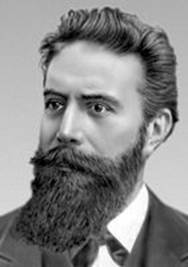
 Wilhelm Conrad Röntgen (27.03.1845 - 10.02.1923) was a German experimental physicist and a corresponding member of the Berlin Academy of Sciences (1896). He was born in Lennep. He graduated from the Zurich Polytechnic (1868). In 1871-73 he worked at the University of Würzburg, in 1874-1879 at the University of Strasbourg, in 1879-1888 he was professor at the University of Giessen and director of the Institute of Physics, in 1888-1900 professor at the University of Würzburg (in 1894 he was elected its rector), and in 1900-1920 professor at the University of Munich and director of the Institute of Physics.
His research was in the field of electromagnetism, the physics of crystals, optics and molecular physics. In 1895 he discovered radiation of a wavelength shorter than that of ultraviolet light (X-rays), later named Röntgen rays after him, and studied its properties: its ability to be reflected, to be absorbed, to ionise air and so on. He proposed the correct design of a tube for producing X-rays - a slanted platinum anticathode and a concave cathode; he was the first to take photographs by means of X-rays. In 1885 Röntgen discovered the magnetic field of a dielectric moving in an electric field (the so-called Röntgen current). His experiment showed clearly that a magnetic field is created by moving charges, and it was of great importance for Lorentz's creation of the electron theory. A considerable number of Röntgen's papers dealt with the properties of liquids, gases and crystals and with electromagnetic phenomena; Röntgen detected a connection between electrical and optical phenomena in crystals. For the discovery of the rays that bear his name, Röntgen in 1901 became the first physicist to be awarded the Nobel Prize.
Röntgen's pupils included M. Wien, A. F. Ioffe, P. Knipping, R. Ladenburg, P. Pringsheim, W. Friedrich and others. Rumford Medal (1896).