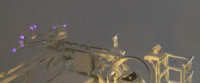
 St Elmo's fire is a kind of continuous spark discharge.
St Elmo's fire can appear when a high electrical voltage acts on a gas. St Elmo's fire is seen during thunderstorms, when the ground is electrically charged and there is a high voltage in the air between the cloud and the ground. The voltage tears apart the molecules of the air, and the gas begins to glow. About 30 000 V per centimetre of space is needed for St Elmo's fire to appear (although sharp points can cause it at lower voltage levels).
St Elmo's fire is a plasma. An ordinary gas consists of molecules. Molecules consist of atoms, which in turn consist of electrons and protons. If the electric force applied to each particle of the gas exceeds a certain voltage level, it forces the electrons and protons of the gas molecules to move apart. The high voltage turns the gas into a glowing mixture of separate beams of protons and electrons. This mixture of particles is called "plasma", and it is a conducting medium. It also fluoresces. The colour of the glow depends on the type of gas. If the atmosphere were neon gas, St Elmo's fire would be red or orange, and lightning would be white with orange edges. Our atmosphere consists of nitrogen and oxygen, and this mixture glows blue and violet. St Elmo's fire is sometimes mistaken for ball lightning. Ball lightning can drift like a soap bubble, whereas St Elmo's fire is always attached to an object. Air is a good electrical insulator. However, if the electric field at the end of a metal rod is strong, the air molecules in its vicinity become ionised. Because the electric field is strengthened in regions of high curvature, discharges are strengthened at the end of pointed metal rods. These "corona discharges" give a faint light, visible in the dark. St Elmo's fire is an example of a continuous corona discharge. It is not a form of lightning. The glow of St Elmo's fire is sometimes observed at night at the tops of ships' masts. The mast looks as if it were on fire, but it does not burn. St Elmo's fire tends to appear at the end of a thunderstorm. Sailors have traditionally interpreted it as a good omen.