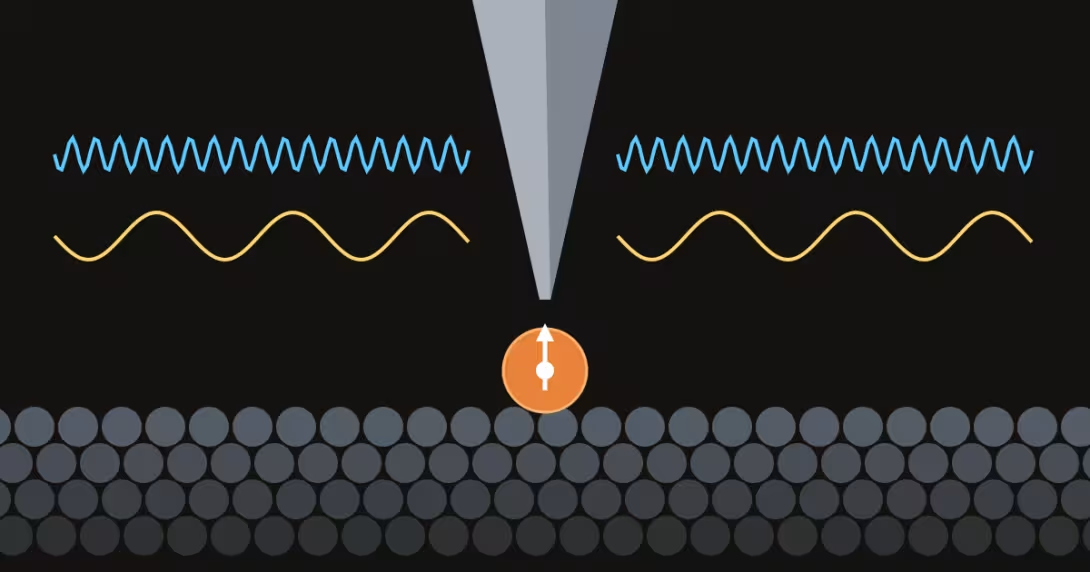
Physicists in Delft have used radio waves to flip the spin of one atom's nucleus, and found a result they cannot yet explain.
If you have ever had an MRI scan, you have met nuclear magnetic resonance. Many atomic nuclei have spin: think of each as a tiny magnet. In a magnetic field such a magnet flips when it is hit by a radio wave of exactly the right frequency. A scanner picks up the response of billions upon billions of nuclei in the body at once. Physicists at Delft University of Technology in the Netherlands have done the same with the nucleus of a single atom.
How it was done
The atom sat on a surface under the needle of a scanning tunnelling microscope, an instrument that feels a surface with a sharp tip and can tell individual atoms apart. Through the tip the team sent two radio signals at once: one tuned to the spin of the electrons, the other to the spin of the nucleus, whose frequencies, the authors say, are a hundred to a thousand times lower. The method, double magnetic resonance, has long been used on large samples; this is the first time it has been brought down to one atom.
The surprise
Until now the nucleus in such experiments was seen only indirectly, through its link to the electrons. Where that link is weak, the nucleus was expected to ignore the tip's electrical signals. It did not. "According to our simple understanding, this should not really happen," says the group's leader, Sander Otte. The mechanism is still open.
Nuclear spins are well shielded from disturbance, which makes them candidates for the memory of future quantum computers. The experiment is not a working quantum memory yet, but it shows a new way to write and read information in a single nucleus. The work is published in Nature Communications.