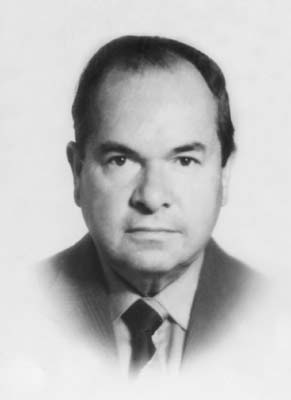
 Alexei Alexeyevich Abrikosov (born 25.06.1928) is a Soviet theoretical physicist and a corresponding member of the USSR Academy of Sciences (1964). He was born in Moscow. In 1948-65 he worked at the Institute of Physical Problems of the USSR Academy of Sciences; from 1965 he was head of a department at the Institute of Theoretical Physics of the USSR Academy of Sciences, from 1966 at the same time professor at Moscow University, and from 1976 head of a department at the Moscow Institute of Steel and Alloys.
His research concerned superconductivity, the theory of solids and of quantum liquids, astrophysics, statistical physics, plasma physics and quantum electrodynamics. In 1954—56 he calculated Green's functions and the effective cross-sections of various high-energy processes in quantum electrodynamics. In 1952 he put forward the idea that type II superconductors exist. In 1957 he constructed the theory of the magnetic properties of superconducting alloys, introducing the idea of two critical fields and of a “mixed” state with a vortex structure of currents — the “Abrikosov vortices” (Lenin Prize, 1966). In 1960, together with L. P. Gorkov, he developed the theory of superconductors with magnetic impurities and predicted gapless superconductivity. He studied the properties of strongly compressed matter and in 1954 gave the equation of state of hydrogen at ultrahigh pressures, with a transition from the molecular to the atomic phase. In 1962—73 he created the theory of semimetals of the bismuth type and predicted the appearance of a gapless state and of excitonic phases in a strong magnetic field. He constructed the theory of gapless semiconductors (1970—74). He worked out a general approach to the study of conduction in quasi-one-dimensional systems and introduced the concept of the delocalisation parameter (1976—77). He created the theory of short-range spin glasses (1978-80). In 1978 he put forward the idea of high-temperature superconductivity in a crystalline excitonic phase with heavy holes — “metallic excitonium”.
The F. London Prize (1972), the USSR State Prize (1982)