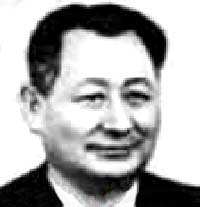
 Ubay Arifovich Arifov (15.06.1909 - 24.XII 1976) was a Soviet physicist, an academician of the Academy of Sciences of the Uzbek SSR (1956) and its president in 1962-66. He was born in Kokand. He graduated from Samarkand University (1931). In 1935—41 he was an assistant at the Central Asian (now Tashkent) University; in 1945—56 and 1963—67 director of the Physico-Technical Institute of the Academy of Sciences of the Uzbek SSR; in 1956-62 of the Institute of Nuclear Physics of the Academy of Sciences of the Uzbek SSR; and in 1966—76 of the Institute of Electronics of the Academy of Sciences of the Uzbek SSR (from 1963 he was also head of a department at the Tashkent Polytechnic Institute). His main work was in physical electronics, the physics of solid surfaces, nuclear and radiation physics, mass spectrometry and solar engineering. He studied non-stationary processes on metal surfaces and developed methods of determining the coefficients of surface ionisation and the heats of adsorption and desorption. He established that the yield of negative ions from a sputtered surface can be greatly increased, and so began the development of sputtering sources of negative ions. He studied the regularities of electron emission under the bombardment of metal crystals and film systems by atomic particles, and worked out the mechanisms of potential and kinetic electron emission for various classes of solid surface. He proved that the properties of a surface can be changed in a controlled way by beams of charged particles, and developed methods of ion nitriding, passivation, ion-beam treatment and others. He designed solar furnaces up to 3 m in diameter, solar photoconverters, solar concentrators and other devices. State Prize of the Uzbek SSR. Editor-in-chief of the journals “Reports of the Academy of Sciences of the Uzbek SSR” (1962—66) and “Applied Solar Energy” (1965-76).
Arifov, Ubay Arifovich
Ubay Arifovich Arifov (15.06.1909 - 24.XII 1976) was a Soviet physicist, an academician of the Academy of Sciences of the Uzbek SSR (1956) and its president in 1962-66. He was born in Kokand. He graduated from Samarkand University (1931). In 1935—41 he was an assistant at the Central Asian (now Tashkent) University; in 1945—56 and 1963—67 director of the Physico-Technical Institute of the Academy of Sciences of the Uzbek SSR; in 1956-62 of the Institute of Nuclear Physics of the Academy of Sciences of the Uzbek SSR; and in 1966—76 of the Institute of Electronics of the Academy of Sciences of the Uzbek SSR (from 1963 he was also head of a department at the Tashkent Polytechnic Institute). His main work was in physical electronics, the physics of solid surfaces, nuclear and radiation physics, mass spectrometry and solar engineering. He studied non-stationary processes on metal surfaces and developed methods of determining the coefficients of surface ionisation and the heats of adsorption and desorption. He established that the yield of negative ions from a sputtered surface can be greatly increased, and so began the development of sputtering sources of negative ions. He studied the regularities of electron emission under the bombardment of metal crystals and film systems by atomic particles, and worked out the mechanisms of potential and kinetic electron emission for various classes of solid surface. He proved that the properties of a surface can be changed in a controlled way by beams of charged particles, and developed methods of ion nitriding, passivation, ion-beam treatment and others. He designed solar furnaces up to 3 m in diameter, solar photoconverters, solar concentrators and other devices. State Prize of the Uzbek SSR. Editor-in-chief of the journals “Reports of the Academy of Sciences of the Uzbek SSR” (1962—66) and “Applied Solar Energy” (1965-76).