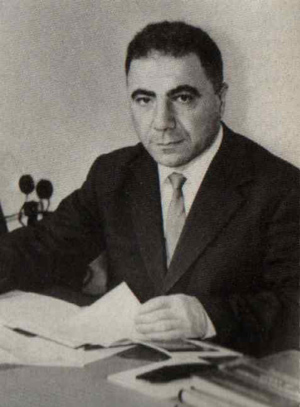
 Viktor Amazaspovich Ambartsumian (born 18.09.1908) was a Soviet astrophysicist and physicist, academician (1953), academician of the Academy of Sciences of the Armenian SSR (1943) and its president (from 1947). Born in Tbilisi. He graduated from Leningrad University (1928) and in 1934 — 43 was professor at that university. In 1943 he moved to Yerevan to work at the Academy of Sciences of the Armenian SSR. From 1946 he was director of the Byurakan Astrophysical Observatory and professor at Yerevan University. His research concerned the physics of stars and nebulae, stellar dynamics, extragalactic astronomy and cosmogony, and nuclear physics. In 1930, with D. D. Ivanenko, he suggested that the nucleus contains only heavy particles and explained the emission of electrons by nuclei as their “creation”, by analogy with the emission of photons; with him he also developed (1930) a theory of discrete space-time. He carried out important research on the mathematical theory of the scattering of light in a turbid medium (USSR State Prize, 1946). He considered in general form the problem of radiative transfer, which is of enormous importance for astrophysics. He was the first to put forward the idea of the patchy structure of the absorbing matter in the Galaxy, and on that basis he developed a theory of the brightness fluctuations of the Milky Way. He laid the foundations of the statistical mechanics of stellar systems and in particular established that the lifetime of the Galaxy is no more than 1010 years. Studying the evolution of star clusters, he discovered in 1947 a new type of stellar system, dynamically unstable and disintegrating — groups of young stars (stellar associations) — and so proved that the process of star formation in the Universe is continuing at the present day (USSR State Prize, 1950). He was the author of the hypothesis that stars and diffuse nebulae originate together from dense bodies of non-stellar nature. He developed a theory of baryon stars, whose density exceeds nuclear density. His research of recent years concerned the problem of the origin and evolution of galaxies. He was the first to develop the idea of the cosmogonic activity of the nuclei of galaxies, which determines the most important non-stationary processes in the evolution of galaxies — giant explosions, the ejection of considerable masses of matter, powerful radio emission and so on. In particular, proceeding from this idea, he showed that radio galaxies are not the result of a chance collision of two galaxies, as was thought after their discovery, but an active stage in the evolution of galaxies. He put forward a new view of the sources of stellar energy, arguing for example for the non-thermonuclear nature of stellar energy. Twice Hero of Socialist Labour (1968, 1978). He founded a school of astrophysicists. A member of many academies of sciences and scientific societies. In 1961—64 he was president of the International Astronomical Union. The M. V. Lomonosov and S. I. Vavilov Gold Medals, the P. Janssen and H. Helmholtz Medals and others. Editor-in-chief of the journal Astrophysics (from 1965).
Ambartsumian, Viktor Amazaspovich
Viktor Amazaspovich Ambartsumian (born 18.09.1908) was a Soviet astrophysicist and physicist, academician (1953), academician of the Academy of Sciences of the Armenian SSR (1943) and its president (from 1947). Born in Tbilisi. He graduated from Leningrad University (1928) and in 1934 — 43 was professor at that university. In 1943 he moved to Yerevan to work at the Academy of Sciences of the Armenian SSR. From 1946 he was director of the Byurakan Astrophysical Observatory and professor at Yerevan University. His research concerned the physics of stars and nebulae, stellar dynamics, extragalactic astronomy and cosmogony, and nuclear physics. In 1930, with D. D. Ivanenko, he suggested that the nucleus contains only heavy particles and explained the emission of electrons by nuclei as their “creation”, by analogy with the emission of photons; with him he also developed (1930) a theory of discrete space-time. He carried out important research on the mathematical theory of the scattering of light in a turbid medium (USSR State Prize, 1946). He considered in general form the problem of radiative transfer, which is of enormous importance for astrophysics. He was the first to put forward the idea of the patchy structure of the absorbing matter in the Galaxy, and on that basis he developed a theory of the brightness fluctuations of the Milky Way. He laid the foundations of the statistical mechanics of stellar systems and in particular established that the lifetime of the Galaxy is no more than 1010 years. Studying the evolution of star clusters, he discovered in 1947 a new type of stellar system, dynamically unstable and disintegrating — groups of young stars (stellar associations) — and so proved that the process of star formation in the Universe is continuing at the present day (USSR State Prize, 1950). He was the author of the hypothesis that stars and diffuse nebulae originate together from dense bodies of non-stellar nature. He developed a theory of baryon stars, whose density exceeds nuclear density. His research of recent years concerned the problem of the origin and evolution of galaxies. He was the first to develop the idea of the cosmogonic activity of the nuclei of galaxies, which determines the most important non-stationary processes in the evolution of galaxies — giant explosions, the ejection of considerable masses of matter, powerful radio emission and so on. In particular, proceeding from this idea, he showed that radio galaxies are not the result of a chance collision of two galaxies, as was thought after their discovery, but an active stage in the evolution of galaxies. He put forward a new view of the sources of stellar energy, arguing for example for the non-thermonuclear nature of stellar energy. Twice Hero of Socialist Labour (1968, 1978). He founded a school of astrophysicists. A member of many academies of sciences and scientific societies. In 1961—64 he was president of the International Astronomical Union. The M. V. Lomonosov and S. I. Vavilov Gold Medals, the P. Janssen and H. Helmholtz Medals and others. Editor-in-chief of the journal Astrophysics (from 1965).