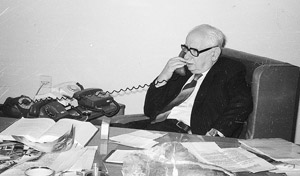
 Elevter Luarsabovich Andronikashvili (born 25.XII 1910) is a Soviet experimental physicist and an academician of the Academy of Sciences of the Georgian SSR (1955). He graduated from the Leningrad Polytechnic Institute (1932); in 1934—40 he taught at Tbilisi University, and in 1940—41 and 1945—48 he was a doctoral student at the Institute of Physical Problems of the USSR Academy of Sciences. Since 1951 he has been director of the Institute of Physics of the Academy of Sciences of the Georgian SSR and professor and head of a department at Tbilisi University. His research concerned low-temperature physics, the physics of cosmic rays, the radiation physics of solids, nuclear engineering and biophysics. The experiments on the superfluidity of liquid helium that Andronikashvili carried out at the Institute of Physical Problems of the USSR Academy of Sciences began the study of quantum hydrodynamics. He studied the properties of liquid helium II and proved experimentally (1946) that helium II has two components, a normal one and a superfluid one (USSR State Prize, 1952).
In 1961 he built the first low-temperature loop in this country, of an original design, which makes it possible to irradiate various substances in a nuclear reactor at temperatures close to absolute zero. He carried out studies on the physical principles of powerful gamma-radiation sources in radiation loops. He initiated a new field, biothermodynamics.
Under his direction unique scanning differential microcalorimeters of the adiabatic type were built, with which the heat of intramolecular melting of DNA, RNA and of fibrillar and globular proteins, in the normal and in the pathological state, was measured for the first time. USSR State Prize (1978).