 Aristotle (384-322 BC) was an ancient Greek philosopher and scientist. He was born in Stagira. In 367—347 BC he studied at Plato's Academy in Athens, and in 343—335, at the court of Philip, king of Macedonia, he was tutor to Philip's son Alexander (the future commander). In 335 he returned to Athens, where he founded his own philosophical school, that of the Peripatetics. He had a considerable influence on all the later development of scientific and philosophical thought. His writings cover every field of knowledge of his time. He collected and systematised an enormous body of natural-science material gathered by his predecessors, assessed it critically in the light of his own philosophical views, and himself made a number of profound observations. In the physical treatises “Physics”, “On Generation and Corruption”, “On the Heavens”, “Meteorology”, “Mechanics” and others he set out his ideas about nature and motion. His physics is at bottom speculative. He held the primary qualities of matter to be two pairs of opposites, “hot — cold” and “dry — moist”, and the basic (lowest) elements, or elemental principles, to be earth, air, water and fire (a kind of “system of elements”), which are different combinations of the primary qualities; the union of cold with dry corresponds to earth, of cold with moist to water, of hot with moist to air, and of hot with dry to fire. He held the fifth and most perfect element to be aether. He set out his views on the world in his cosmology, which dominated science until N. Copernicus. According to Aristotle the universe consists of a series of concentric crystalline spheres which move at different speeds and are set in motion by the outermost sphere of the fixed stars; at the centre of the universe lies the spherical motionless Earth, around which the planets revolve in concentric circles. The region between the orbit of the Moon and the centre of the Earth (the so-called sublunary world) is a region of disordered, non-uniform motions, and all the bodies in it consist of the four lower elements: earth, water, air and fire. The Earth, as the heaviest element, occupies the central place, and above it lie in turn the shells of water, air and fire. The region between the orbit of the Moon and the outermost sphere of the fixed stars (the so-called superlunary world) is a region of eternal uniform motions, and the stars themselves consist of the fifth element, aether. Aristotle's research also covered mechanics, acoustics and optics. In particular, he explained sound as a “shaking” of the air by the sounding body and echo as the reflection of sound, and he argued against Euclid's theory of vision. Aristotle's physics, based on the principle of purposiveness in nature, did contain some correct propositions, but at the same time it discarded the progressive ideas of his predecessors, among them the ideas of heliocentrism and atomism. Canonised by the church, Aristotle's teaching held back the further development of science; the medieval churchmen emasculated his teaching, they “killed the living in Aristotle and immortalised the dead”. After a thousand years of stagnation and sterility, science was reborn only in the 15th—16th centuries, in the struggle against Aristotle's views.
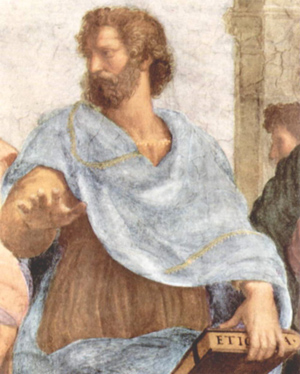
Aristotle
Aristotle (384-322 BC) was an ancient Greek philosopher and scientist. He was born in Stagira. In 367—347 BC he studied at Plato's Academy in Athens, and in 343—335, at the court of Philip, king of Macedonia, he was tutor to Philip's son Alexander (the future commander). In 335 he returned to Athens, where he founded his own philosophical school, that of the Peripatetics. He had a considerable influence on all the later development of scientific and philosophical thought. His writings cover every field of knowledge of his time. He collected and systematised an enormous body of natural-science material gathered by his predecessors, assessed it critically in the light of his own philosophical views, and himself made a number of profound observations. In the physical treatises “Physics”, “On Generation and Corruption”, “On the Heavens”, “Meteorology”, “Mechanics” and others he set out his ideas about nature and motion. His physics is at bottom speculative. He held the primary qualities of matter to be two pairs of opposites, “hot — cold” and “dry — moist”, and the basic (lowest) elements, or elemental principles, to be earth, air, water and fire (a kind of “system of elements”), which are different combinations of the primary qualities; the union of cold with dry corresponds to earth, of cold with moist to water, of hot with moist to air, and of hot with dry to fire. He held the fifth and most perfect element to be aether. He set out his views on the world in his cosmology, which dominated science until N. Copernicus. According to Aristotle the universe consists of a series of concentric crystalline spheres which move at different speeds and are set in motion by the outermost sphere of the fixed stars; at the centre of the universe lies the spherical motionless Earth, around which the planets revolve in concentric circles. The region between the orbit of the Moon and the centre of the Earth (the so-called sublunary world) is a region of disordered, non-uniform motions, and all the bodies in it consist of the four lower elements: earth, water, air and fire. The Earth, as the heaviest element, occupies the central place, and above it lie in turn the shells of water, air and fire. The region between the orbit of the Moon and the outermost sphere of the fixed stars (the so-called superlunary world) is a region of eternal uniform motions, and the stars themselves consist of the fifth element, aether. Aristotle's research also covered mechanics, acoustics and optics. In particular, he explained sound as a “shaking” of the air by the sounding body and echo as the reflection of sound, and he argued against Euclid's theory of vision. Aristotle's physics, based on the principle of purposiveness in nature, did contain some correct propositions, but at the same time it discarded the progressive ideas of his predecessors, among them the ideas of heliocentrism and atomism. Canonised by the church, Aristotle's teaching held back the further development of science; the medieval churchmen emasculated his teaching, they “killed the living in Aristotle and immortalised the dead”. After a thousand years of stagnation and sterility, science was reborn only in the 15th—16th centuries, in the struggle against Aristotle's views.