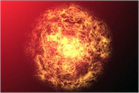
 One of the little-studied natural phenomena is ball lightning. The first mention of this phenomenon dates from the 6th century, in the writings of Bishop Gregory of Tours.
Since then tens of thousands of different accounts by eyewitnesses of encounters with ball lightning have accumulated.
Ball lightning is natural electricity that exists in the form of lightning that is spherical, pear-shaped or oval, with a luminous brightness equivalent to a lamp of 60-100 W. The glow of ball lightning has a wide range of colours, but shades of yellow, orange and red predominate. The colour may be non-uniform, and it may also change during the “life” of the lightning, which usually does not exceed 10 seconds. The diameter of ball lightning lies in the range from 5 to 30 cm. The speed of movement of the lightning is less than 1.0 m/s. According to scientists, the temperature of ball lightning lies in the range from 100 to 1400°C. However, eyewitnesses of the phenomenon have not noted any rise in temperature near the lightning. Scientists have established that, whatever the size, shape and colour of ball lightning, its mass does not exceed 7 grams. The behaviour of ball lightning is unpredictable. In some cases ball lightning disappears silently, in others it “explodes” with a fairly loud bang, sometimes destroying an object nearby. Having appeared near a person, the lightning may either move about without approaching him or “attack”. The result of such an “attack” may be injuries both compatible and incompatible with life. One of the mysteries of ball lightning is that the body of a person killed by lightning does not stiffen or decompose for a long time. There is an opinion that on meeting ball lightning one should avoid sudden movements. It was previously assumed that ball lightning can occur only during a thunderstorm, but lightning has also been seen in clear, sunny weather. At present there are more than 100 theories of the origin of ball lightning.
According to the main hypothesis about ball lightning, it is an object of complex structure formed by randomly joined particles of carbon. Because of its fractal nature, this object has a large surface area and a low density. This helps the lightning to move through the air and to sustain its release of energy for a relatively long time through slow oxidation, that is, the “life” of the ball lightning.
Although many scientists (J. Turner, J. Abrahamson, J. Dinniss, B. Smirnov, I. Stakhanov, I. Imyanitov, D. Tikhiy and others) have tried to solve the “mystery” of the nature of ball lightning, no final answer has yet been obtained.