AIM OF THE EXPERIMENT: To find out what part the tail of a kite plays.
MATERIALS: one sheet of writing paper, scissors, sticky tape, string, a ruler.
MATERIALS: one sheet of writing paper, scissors, sticky tape, string, a ruler.
Изображение
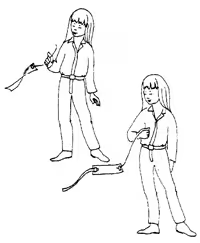
METHOD:
Measure and cut a strip 5 x 30 cm from the sheet of paper.
Cut a piece of string about half a metre long and tape it to the paper strip.
Take hold of the end of the string and swing it in front of you like a whip.
Measure and cut out a paper strip 0.5 x 30 cm and tape it to the free end of the strip cut earlier.
Make the same movements with these two joined strips as you made before with one.
RESULTS: The paper strip spins, but once the other strip has been attached to it, it has become steadier.
WHY? The paper moves at an angle to the direction of motion, and so the air above the upper part of the strip moves faster. But a fast-moving airflow creates a rarefaction, and because of this the strip experiences lift. Since this angle changes constantly, the lift acting on it, and the irregularities and eddies of the airflow as well, also change constantly. Because of all this the strip flaps and spins. The tail made from a narrow strip of paper and fixed to the strip stabilises the angle at which the wider strip moves relative to the oncoming airflow. Thanks to this the oncoming flow becomes more uniform, and the paper strip spins and swings about less.