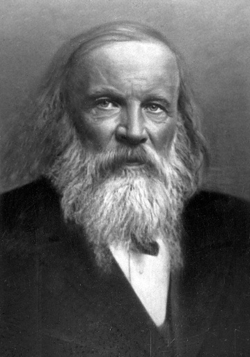
 Dmitri Ivanovich Mendeleev (8.02.1834—2.02.1907) was a Russian scientist and a corresponding member of the St Petersburg Academy of Sciences (1876). He was born in Tobolsk. He graduated from the Main Pedagogical Institute in St Petersburg (1855). In 1857-90 he taught at St Petersburg University (professor from 1865). In 1890 he left the university because of a conflict with the Minister of Education, I. D. Delyanov.
From 1892 he was scientific curator of the Depot of Standard Weights and Balances, which on his initiative was reorganised in 1893 into the Main Chamber of Weights and Measures (now the D. I. Mendeleev All-Union Research Institute of Metrology), and he was its head in 1893 — 1907. His work was mainly in the field of chemistry, and also in physics, metrology, meteorology and others.
In 1869 he discovered one of the fundamental laws of nature — the periodic law of the chemical elements — and on its basis he created the periodic table of the chemical elements. He corrected the values of the atomic weights of many elements (beryllium, indium, uranium, thorium, cerium and others), predicted the existence and the properties of new elements that had not yet been discovered (gallium, germanium, scandium) and calculated their atomic weights approximately. Later discoveries brilliantly confirmed Mendeleev's periodic law, which became the basis of the modern science of matter.
He predicted the existence of the critical temperature (1860) and, generalising the Clapeyron equation, found in 1874 the general equation of state of an ideal gas (the Mendeleev–Clapeyron equation). He designed a barometer. In 1887 he made a balloon flight (without a pilot) to observe a solar eclipse and to study the upper layers of the atmosphere. In the field of metrology he developed a physical theory of the balance, designs for the beam and the arrester, precise techniques of weighing and others. In 1888 he was the first to put forward the idea of the underground gasification of coal. In his scientific work he took the position of materialism and fought against idealism in natural science.
In honour of D. I. Mendeleev the USSR Academy of Sciences established a prize and a gold medal for the best work in chemistry. His name was given to the 101st element — mendelevium.
A member of many foreign academies of sciences and scientific societies.