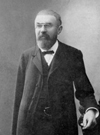
 Henri Poincaré (29.04.1854-17.07.1912) — French mathematician, physicist, astronomer and philosopher, a member of the Paris Academy of Sciences (1887). Born in Nancy. Studied at the École Polytechnique and graduated from the École des Mines (1879). From 1881 he worked at the University of Paris (from 1886 head of a chair).
In 1883-97 he was a tutor, and in 1904 —08 a professor, at the École Polytechnique, and from 1902 also head of a chair at the Higher School of the Ministry of Communications. As a mathematician Poincaré enriched almost every area of the subject with results of the first importance. Applying mathematics in astronomy and physics, he opened with his works a new page in the history of celestial mechanics. Poincaré's physical research concerned the theory of relativity, thermodynamics, electricity, optics, the theory of elasticity and molecular physics. In 1904—05 he stated the principle of relativity as a universal and strict proposition and showed that absolute motion cannot be detected, starting from the notion of the ether and from the Maxwell—Lorentz equations. He introduced the terms “Lorentz transformation” and “Lorentz group”. Independently of A. Einstein he laid the foundations of special relativity. He constructed the first version of a relativistic theory of gravitation.
As a philosopher Poincaré is known for his works on general methodological problems of science, and leaned towards the Machists. In his interpretation of science and its laws he is the founder of conventionalism. V. I. Lenin criticised his philosophical views in his work “Materialism and Empirio-criticism”.
An honorary member of many academies of sciences, including a corresponding member of the St Petersburg Academy of Sciences (1895). The medals of J. Sylvester, N. I. Lobachevsky and others.