AIM OF THE EXPERIMENT: To understand why popcorn jumps.
MATERIALS: corn kernels, a popcorn maker (a frying pan may do instead), a grown-up helper.
MATERIALS: corn kernels, a popcorn maker (a frying pan may do instead), a grown-up helper.
Изображение
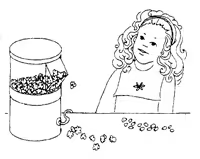
Look at the shape and size of the corn kernels.
Ask your grown-up helper to start the popcorn maker.
Watch how the shape and size of the kernels change as they heat up.
RESULTS: The kernels, which were small, hard and orange, have become big, soft, white and round.
WHY? A corn kernel is “packed” inside a hard hull. It is this hull that gets stuck in your teeth when you eat popcorn. Inside, the kernel is full of starch, which swells when it is heated and turns into a white fluffy mass. The explosion happens because of the small amount of water the kernel holds. When heated, this water evaporates — it turns into a gas (steam). The expanding gas presses on the hull from inside so hard that the hull bursts and the swelling starch breaks out. The popping is the noise of the escaping steam and of the pericarp tearing open.
METHOD: