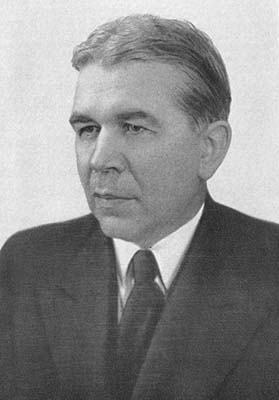
 Sergei Ivanovich Vavilov (24.03.1891—25.01.1951) — Soviet physicist and public figure, academician (1932; corresponding member 1931), President of the USSR Academy of Sciences (from 1945). Born in Moscow. He graduated from Moscow University (1914). In 1914–18 he was on military service. In 1918–30 he was head of the physical optics section of the Institute of Physics and Biophysics of the People's Commissariat of Health of the RSFSR, and also taught (1918–32) at Moscow University (from 1929 professor and head of a chair). In 1932–45 he was scientific director of the State Optical Institute and head of a laboratory, and from 1932 director of the Physical Institute of the USSR Academy of Sciences (from 1934 head of the luminescence laboratory). His main work was in physical optics, and in particular on luminescence and the nature of light. He established the basic laws governing the energetics of luminescence, discovered (1927) that the quantum yield of luminescence depends on the wavelength of the exciting radiation (Vavilov's law), and found (1923), together with V. L. Levshin, the first nonlinear effect in optics. He did much for the practical use of luminescence, in particular in lighting. Vavilov and his pupils developed highly efficient fluorescent lamps and methods of luminescence analysis, and created ultraviolet and luminescence microscopy. An outstanding discovery was made under Vavilov's direction. In 1934 his pupil P. A. Cherenkov found a peculiar glow of pure liquids under the action of gamma rays (the Vavilov—Cherenkov effect). An explanation of this phenomenon was soon given by I. E. Tamm and I. M. Frank. For the discovery and explanation of this phenomenon P. A. Cherenkov, I. M. Frank and I. E. Tamm were awarded the Nobel Prize in 1958. A substantial series of investigations carried out by Vavilov concerned phenomena that are direct evidence of the quantum nature of light. He laid the foundations of a new line of research, which he called microoptics.
As a historian of science Vavilov is widely known for his work on I. Newton and M. V. Lomonosov. He translated Newton's “Opticks” into Russian and supplied it with a commentary and notes, wrote a scientific biography of Newton and a book on the life and scientific work of Lomonosov, and more besides. In 1934 he founded the series “Classics of Science”. From 1938 he headed the Commission on the History of the USSR Academy of Sciences. He also gave considerable attention to the philosophical questions of natural science, arguing actively against the idealist conceptions of bourgeois philosophers and physicists. His works “Lenin and Modern Physics” and “The New Physics and Dialectical Materialism” are widely known. Vavilov had a talent for combining research with the wide popularisation of the achievements of science and the study of its history. His books “The Eye and the Sun” and “On Warm and Cold Light” and others, which became classics of Soviet popular-science literature, are models of popular scientific writing. He was one of the initiators of the Znanie Society and its first chairman (from 1947).
He did much for scientific publishing in the USSR as chairman of the Editorial and Publishing Council of the USSR Academy of Sciences (from 1945), editor-in-chief of the 2nd edition of the Great Soviet Encyclopedia (from 1949) and a member of the editorial boards of a number of series and journals. USSR State Prizes (1943, 1946, 1951). He founded a school of physicists (I. M. Frank, P. A. Cherenkov, S. N. Vernov, V. A. Fabrikant, P. P. Feofilov, E. I. Adirovich, N. A. Dobrotin, A. N. Sevchenko, M. N. Alentsev, V. V. Antonov-Romanovsky, A. M. Bonch-Bruevich, E. M. Brumberg, A. A. Vlasov, M. D. Galanin, L. V. Groshev, M. A. Konstantinova, V. L. Levshin, Z. L. Morgenstern, B. Ya. Sveshnikov, N. A. Tolstoy, V. S. Fursov, I. A. Khvostikov, A. A. Shishlovsky and others).
A member of a number of academies of sciences and scientific societies. In 1951 the Presidium of the USSR Academy of Sciences instituted the S. I. Vavilov gold medal.
The name of S. I. Vavilov has been given to the Institute of Physical Problems of the USSR Academy of Sciences and to the State Optical Institute.