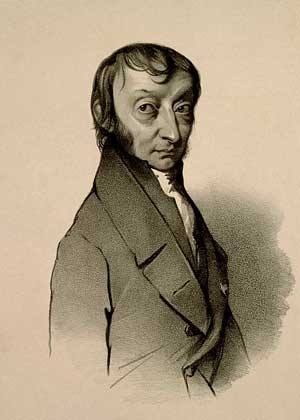
 Amedeo Avogadro (9.08.1776 - 9.07.1856) was an Italian physicist and chemist and a member of the Turin Academy of Sciences (1819). He was born in Turin. He was educated in law. In 1800 he began to study physics and mathematics on his own. From 1806 he was a demonstrator at the college attached to the Turin Academy, from 1809 professor at the college of Vercelli, and in 1820—22 and 1834—50 head of the department of mathematical physics at the University of Turin.
His main work in physics concerned molecular physics. With his very first studies in this field he laid the foundations of molecular theory, putting forward the molecular hypothesis in 1811 in his “Essay on a Manner of Determining the Relative Masses of the Elementary Molecules of Bodies and the Proportions in Which They Enter into Compounds”.
In 1811 he discovered a law important for both physics and chemistry, by which equal volumes of different gases under the same conditions contain the same number of molecules (Avogadro's law). Starting from his law, he developed a method of determining molecular and atomic weights. He was the author of the four-volume work “Physics of Ponderable Bodies, or a Treatise on the General Constitution of Bodies” (1837—41), which was the first manual of molecular physics.